

There is a law of the universe so reliable that physicists treat it as nearly sacred: things fall apart. Ice melts into puddles. Coffee cools to room temperature. Rooms — left to their own devices — become messy. And no matter how long you wait, you will never walk into a kitchen and find that the spilled sugar has spontaneously arranged itself back into a neat pile.
This is the Second Law of Thermodynamics, and hiding inside it is one of the most beautiful and counterintuitive ideas in all of mathematics: entropy. It is also, once you see it clearly, an idea that belongs just as much to probability theory as it does to physics.
Let’s build it from the ground up.
What Is Entropy, Really?
The word “entropy” sounds intimidating, but the core idea is surprisingly democratic: entropy is a measure of how many ways something can be arranged.
Here’s a concrete way to feel this. Suppose you have four coins, and you flip all of them. What are the possible outcomes?
You could get 4 heads. There’s exactly 1 way that can happen: HHHH.
You could get 3 heads and 1 tail. There are 4 ways: HHHT, HHTH, HTHH, THHH.
You could get 2 heads and 2 tails. There are 6 ways: HHTT, HTHT, HTTH, THHT, THTH, TTHH.
You could get 1 head and 3 tails. There are 4 ways (mirror of the 3-heads case).
You could get 0 heads. There’s exactly 1 way: TTTT.
Now here’s the key question: if you flip the four coins randomly, which outcome is most likely? The 2-heads-2-tails outcome, because it has the most arrangements — 6 out of a total of 16 possible outcomes, giving it a 37.5% chance. The “perfectly ordered” states (all heads or all tails) each have only a 1-in-16 chance.
This is entropy in its purest form. The disordered, mixed state wins not because of any mysterious force, but because there are simply more ways to be disordered than ordered.
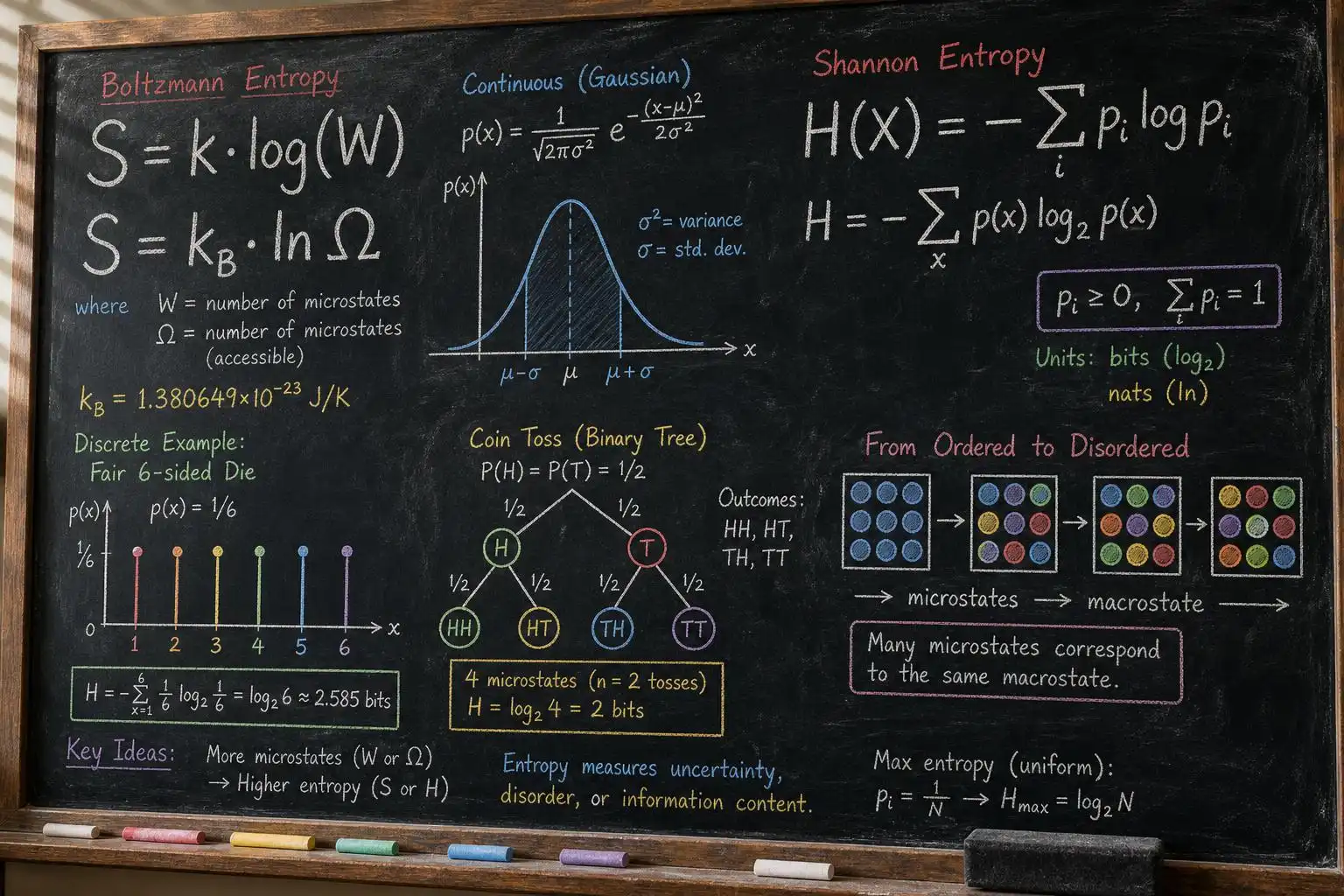
The Boltzmann Formula
The physicist Ludwig Boltzmann made this idea precise in 1877 with one of the most famous equations in science:
S = k · log(W)
Where:
- S is the entropy of a system
- k is Boltzmann’s constant (a tiny number that converts between microscopic and human-scale energy units)
- W is the number of distinct microscopic arrangements — called microstates — that produce the same observable state
The logarithm is doing something elegant here. If you have two independent systems with W₁ and W₂ microstates respectively, the combined system has W₁ × W₂ microstates (you multiply possibilities when combining independent things). But we want entropy to be additive — the entropy of the combined system should be the sum of the individual entropies. The logarithm converts that multiplication into addition, because log(W₁ × W₂) = log(W₁) + log(W₂).
This is why logarithms appear so naturally throughout information theory, physics, and probability: they are the mathematical bridge between “counting arrangements” and “adding up contributions.”
A Room of Its Own
Let’s scale the coin-flip intuition up to something more physical. Imagine a small box divided into two halves, with 100 air molecules bouncing around inside. You start with all 100 molecules crammed into the left half — a very “ordered” state.
How many ways can that happen? Just 1: every molecule is on the left.
Now you remove the divider. The molecules spread out. After a moment, roughly 50 are on each side. How many ways can that happen? You need to choose which 50 of the 100 molecules are on the left — that’s the combination C(100, 50), which is approximately 10²⁹ (a 1 followed by 29 zeros).
The ratio between the disordered state and the ordered state is 10²⁹ to 1. The probability of all 100 molecules spontaneously returning to the left half is 1 in 2¹⁰⁰ — a number so small it’s essentially zero. You’d need to wait longer than the age of the universe many times over.
Your room doesn’t clean itself for the same reason. The number of “messy” arrangements of your books, clothes, and dishes dwarfs the number of “tidy” arrangements by astronomical factors. Disorder isn’t a force — it’s just the overwhelming weight of probability.
Shannon Entropy: The Information Connection
Here’s where things get wonderfully strange. In 1948, the mathematician Claude Shannon was working on a completely different problem: how to measure the information content of a message. He arrived at a formula that looks almost identical to Boltzmann’s:
H = −Σ p(x) · log₂(p(x))
Where the sum runs over all possible messages x, and p(x) is the probability of each message. Shannon called this quantity information entropy, and it measures how surprising or unpredictable a source of information is.
Let’s work through a small example. Suppose you’re receiving a message that is always the letter “A.” There’s no surprise — you always know what’s coming. Shannon entropy: 0 bits. No information is being transmitted because nothing is uncertain.
Now suppose the message is equally likely to be any of the 26 letters of the alphabet. Each letter has probability 1/26. The Shannon entropy is:
H = −26 × (1/26) × log₂(1/26) = log₂(26) ≈ 4.7 bits
That means each letter you receive carries about 4.7 bits of genuine information — because you genuinely couldn’t predict it. The more unpredictable (disordered) a source, the higher its entropy.
This isn’t a coincidence or a metaphor — it’s a deep mathematical unity. Physical entropy and information entropy are measuring the same underlying thing: the number of possibilities consistent with what you know. Boltzmann counted microstates; Shannon counted messages. The logarithm connects them both.
Entropy and the Arrow of Time
Here’s the philosophical payoff. The laws of physics at the microscopic level are almost entirely time-symmetric: a video of two billiard balls colliding looks equally valid played forward or backward. So why does time feel like it has a direction? Why does the past feel different from the future?
The answer is entropy. The Second Law says that entropy in a closed system tends to increase over time — or more precisely, that systems tend to evolve toward states with more microstates, simply because there are more of them. This statistical asymmetry is what gives time its arrow. The reason you remember the past but not the future, the reason causes precede effects, the reason your coffee cools and never spontaneously heats up — all of this traces back to the mathematics of counting arrangements.
The past is the direction of lower entropy. The future is the direction of higher entropy. And the present is wherever you happen to be on that one-way escalator.
A Worked Example: Entropy in Compression
Let’s bring this down to earth with something you use every day: file compression. When your computer compresses a file into a ZIP archive, it is exploiting Shannon entropy.
Consider two files:
- File A: 1,000 characters, all the letter “A”
- File B: 1,000 truly random bytes
File A has very low entropy. The pattern is perfectly predictable, so a compression algorithm can represent it as “repeat A 1,000 times” — just a handful of bytes. The compressed version is tiny.
File B has maximum entropy. There is no pattern to exploit, so the algorithm can’t do better than storing each byte individually. The compressed file is roughly the same size as the original.
This is why already-compressed files (like JPEGs or MP3s) don’t compress further when you ZIP them — they’ve already had their entropy squeezed out. And it’s why encrypted files are nearly impossible to compress: good encryption deliberately maximizes entropy, making the output look like pure random noise with no exploitable structure.
Shannon entropy isn’t just a theoretical curiosity. It sets a hard mathematical floor on how small any lossless compression can make a file. No algorithm, no matter how clever, can compress a maximum-entropy source. That limit is called the Shannon entropy rate, and it’s as fundamental to information theory as the speed of light is to relativity.
The One Insight to Carry Away
Entropy is not a force, a tendency, or a preference. It is pure mathematics: disordered states are overwhelmingly more numerous than ordered ones, so systems wander into disorder simply by exploring their possibilities at random.
This single idea explains why heat flows from hot to cold (hotter objects have molecules moving more randomly and with higher entropy; when heat flows from hot to cold, the total entropy of the combined system increases), why information has a minimum size (Shannon’s limit), why time has a direction (the universe started in an improbably low-entropy state and has been spreading out ever since), and yes — why your room never cleans itself.
The next time you find your desk in chaos, you can take cold comfort in knowing that you are not failing at tidiness. You are simply observing one of the most fundamental mathematical facts in the universe. The disorder isn’t a bug. It’s just the numbers.


Leave a Reply