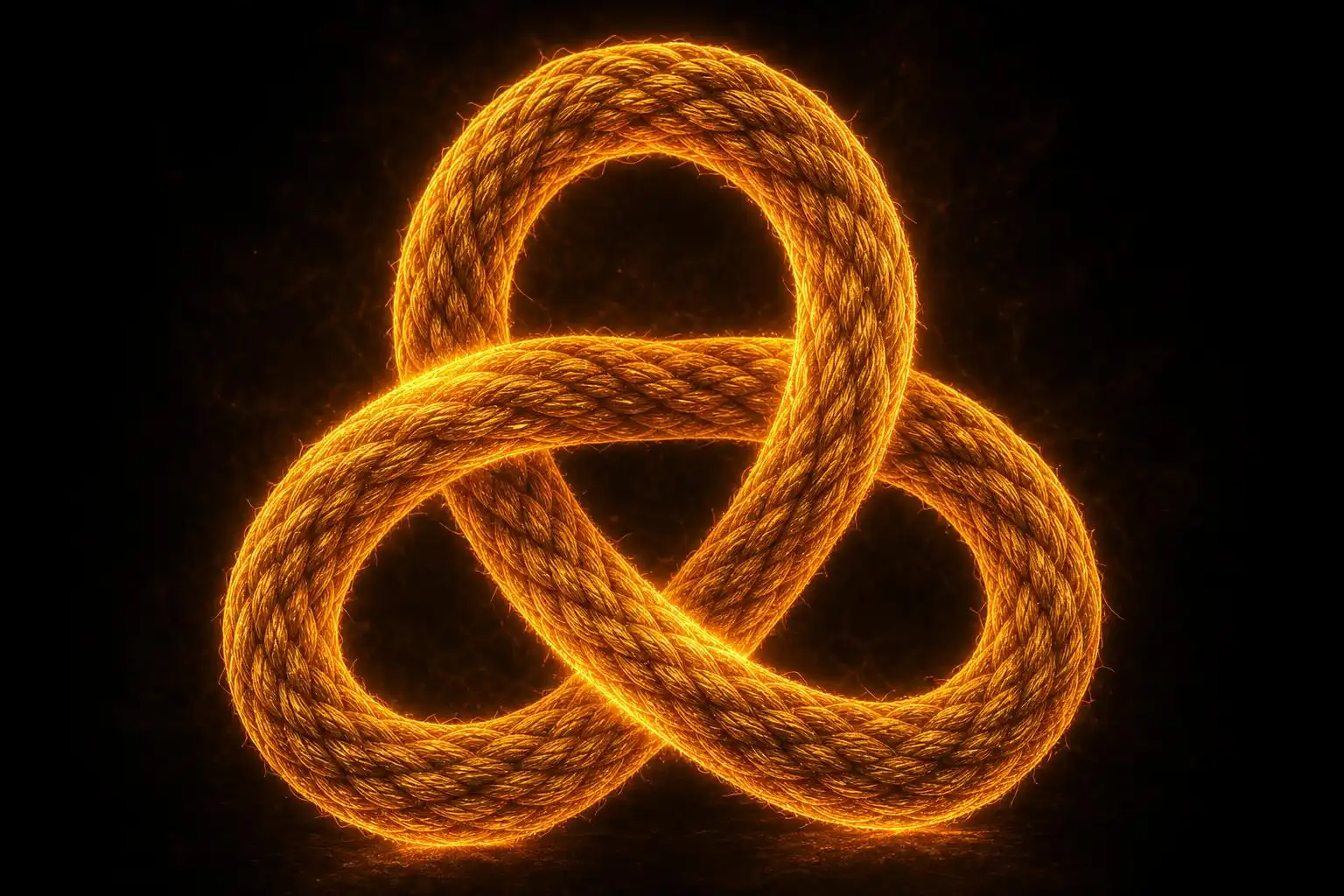

Take a shoelace, tie an overhand knot in it, and then glue the two ends together into a loop. You now have an object that mathematicians call a knot — and no matter how you twist, stretch, or fold that loop without cutting it, you can never make it back into a plain circle. This is strange when you first sit with it. There’s no glue holding the knot in place, no stiffness in the material, nothing physical stopping you from wiggling it smooth. And yet it’s mathematically impossible. Figuring out why is one of the great detective stories in modern mathematics, and it starts with a very simple question: how do you prove two tangled loops are actually different shapes?
The Problem With “Just Looking”
Here’s the trap. If I hand you two loops of string, tangled up in different ways, and ask “are these the same knot?”, you might think you can just look. But knots are slippery — literally and mathematically. The same knot can be posed in wildly different-looking configurations, twisted through three-dimensional space so that a genuine circle (what mathematicians call the “unknot”) can look like an impenetrable snarl.
This is the central technical challenge of knot theory: knots are defined up to something called ambient isotopy, meaning two knots count as “the same” if you can deform one into the other by continuously moving the string through space — stretching, bending, sliding — without ever cutting it or letting strands pass through each other. So a messy-looking tangle and a clean circle might secretly be the same knot, just posed differently, while two tangles that look almost identical might be fundamentally, permanently different. Eyeballing it doesn’t work. You need an invariant — some number, or algebraic object, that you can calculate from a picture of the knot, that gives the same answer no matter which pose the knot happens to be in. If two knots have different invariants, you know for certain they’re different knots. That’s the whole game.
Reidemeister’s Three Moves
The first breakthrough came from a deceptively humble idea. In 1927, the German mathematician Kurt Reidemeister proved that any two drawings of the same knot — any two “the same knot, different pose” pictures — can always be connected by a sequence of just three simple local moves on the diagram. One move lets you twist a loop in or out of a strand. One lets you slide one strand over or under another. One lets you shift a strand across a crossing where two other strands meet. That’s it. Three moves, and they can turn any valid diagram of a knot into any other valid diagram of the same knot.
This matters enormously because it turns an impossible-sounding question — “can I bend this specific piece of string, in three-dimensional space, into that other shape?” — into a precise question about pictures: “does some sequence of these three specific moves take this diagram to that diagram?” It also hands you a recipe for invariants. If you can find some quantity computed from a knot diagram that doesn’t change under any of the three Reidemeister moves, you’ve found something real — a property of the knot itself, not an accident of how you happened to draw it.
Counting Crossings, Coloring Strands
The crudest invariant is just the crossing number: the minimum number of times the strands cross in any diagram of the knot. The unknot has crossing number zero. The simplest actual knot, the trefoil (the shape of a pretzel or a classic overhand knot with the ends joined), has crossing number three — you can draw it with three crossings, and no clever rearranging ever gets it below three. This alone proves the trefoil isn’t the unknot: an honest circle can be drawn with zero crossings, and if the trefoil could too, its crossing number would be zero, not three. But crossing number is hard to compute in general, since checking “no clever arrangement works” for a complicated tangle means checking a lot of arrangements.
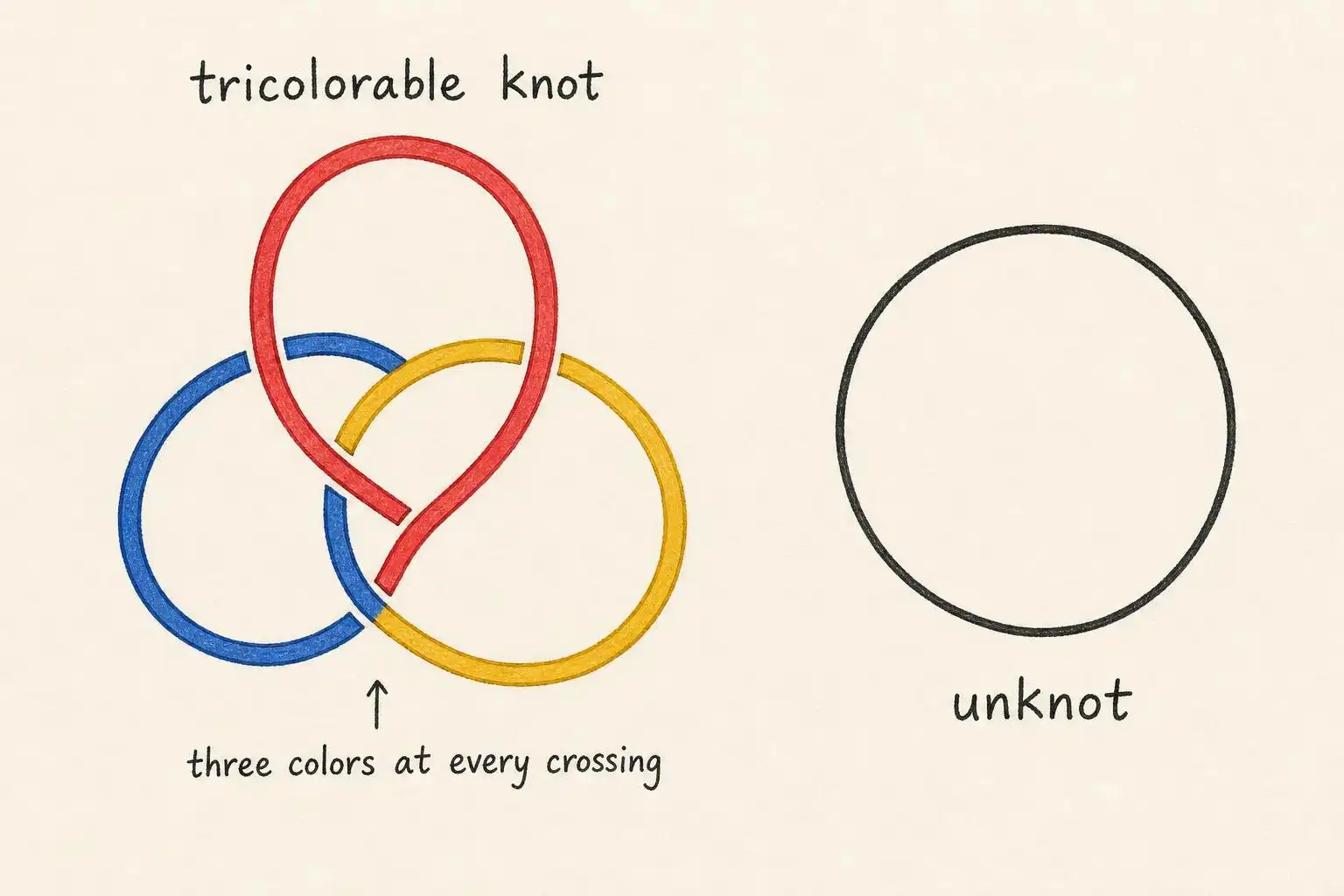
A cleverer, checkable invariant comes from tricolorability. Color each strand of a knot diagram (the segments between undercrossings) with one of three colors, following two rules: use at least two colors total, and at every crossing, the three strands meeting there are either all the same color or all three different colors. If you can pull this off, the knot is “tricolorable.” Here’s the payoff: tricolorability is preserved under all three Reidemeister moves, which means it’s a genuine invariant of the knot, not just the drawing. The unknot is not tricolorable — you’re forced to use just one color. The trefoil is tricolorable — three strands, three different colors, every crossing checks out. Since tricolorability survives any redrawing and the two knots disagree on it, the trefoil can never be untangled into a circle. That’s the whole proof, and you can carry it out with three crayons.
The Polynomial That Cracked It Wide Open
Tricolorability is elegant but blunt: it sorts knots into only two bins, tricolorable or not, so it can’t tell apart the many knots that share a bin. Knot theorists wanted an invariant with more resolution, and in 1984 the New Zealand mathematician Vaughan Jones found one almost by accident, while working on operator algebras — an area of math that, on its face, has nothing to do with tangled loops. He discovered a way to compute a polynomial, a mathematical expression built from a variable and its powers, directly from a knot diagram, such that the polynomial comes out identical for every diagram of the same knot.
The Jones polynomial for the unknot is simply the constant 1. For the trefoil, it works out to something like negative the variable’s inverse fourth power, plus its inverse cube, plus its inverse first power (the exact formula depends on convention, but the key fact is it isn’t 1). Since the two polynomials differ, the trefoil and unknot are provably distinct — the same conclusion tricoloring gave us, but now from a tool sharp enough to also distinguish many knots that tricoloring couldn’t tell apart, including mirror images of each other that look almost identical but are secretly reversed, like a left hand and a right hand. The discovery was such a surprise, connecting such distant corners of mathematics and even later theoretical physics, that Jones won the Fields Medal, mathematics’ highest honor, in 1990.
Why Anyone Outside Mathematics Should Care
It’s tempting to file this under “beautiful but useless,” and for a long time even mathematicians treated knot theory as pure recreation. That changed once biologists looked closely at DNA. DNA molecules are very long and thin: bacterial chromosomes and plasmids are often circular, while eukaryotic chromosomes are generally linear, though all face topological tangling as cells replicate and repair them. Enzymes called topoisomerases exist specifically to cut, rethread, and reseal DNA to manage these tangles, and untangling the wrong way, or failing to untangle at all, can jam replication or trigger cell death. Researchers use knot invariants, including polynomial invariants, to help identify or distinguish DNA knot types and bound how many strand-passing moves an enzyme may need to undo them.
Knot theory also turns up in chemistry, where scientists synthesize genuinely knotted molecules and need invariants to prove two lab-made molecules aren’t secretly identical twisted into different poses, and in physics, where the Jones polynomial’s strange operator-algebra origins turned out to connect to quantum field theory in ways still being explored. The throughline in all of it is the same move you make with three crayons on a trefoil: when a question about physical deformation in space feels impossible to settle by staring at it, find a number or an algebraic object that a deformation can’t change, and let that number settle the argument for you.
The next time you’re wrestling with a snarled charging cable or a knotted necklace chain, you now have the honest answer to why some tangles just won’t come loose — and, more usefully, the mathematician’s instinct for how to actually prove it isn’t in your head.


Leave a Reply