
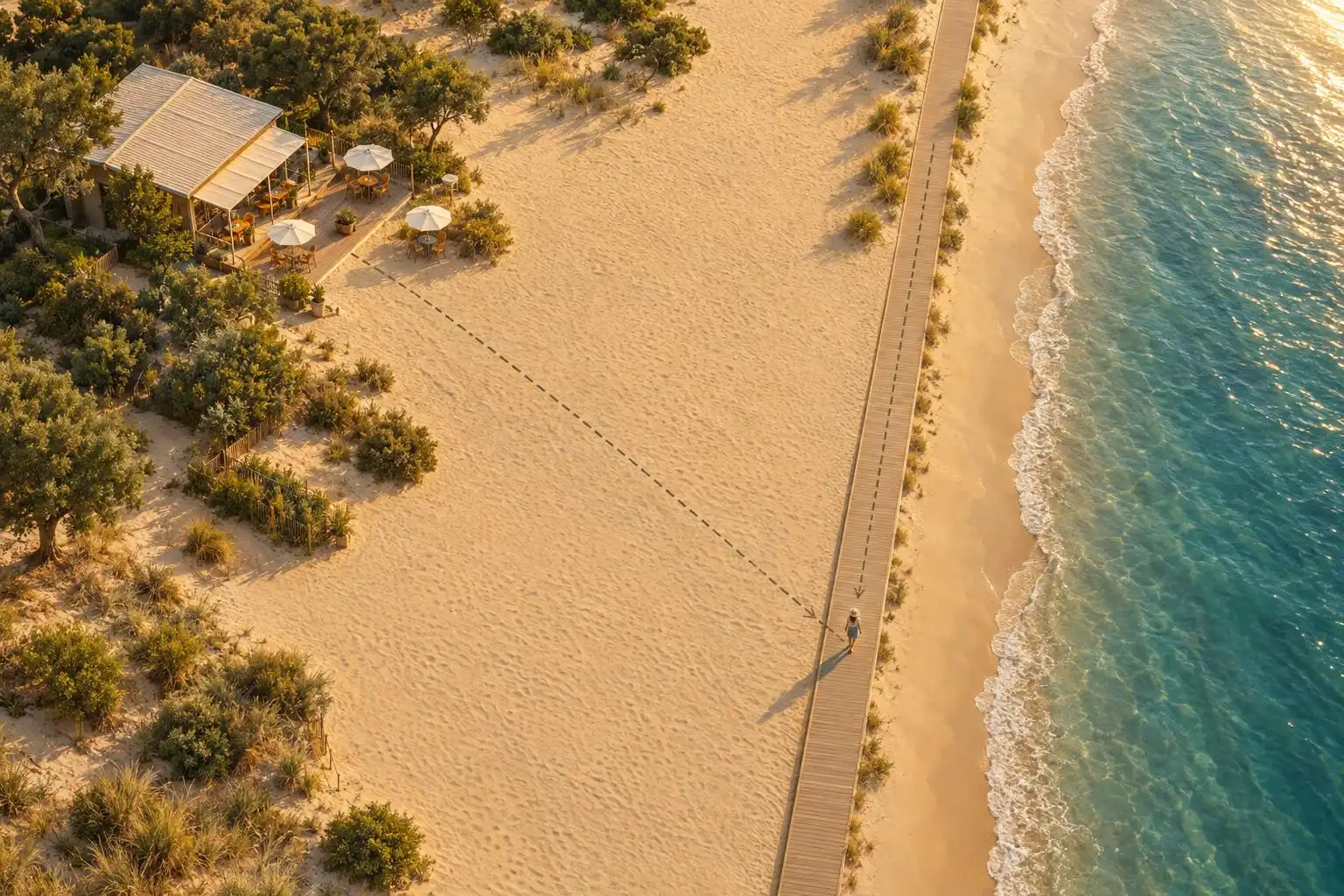

You are standing on a boardwalk, trying to reach a café across a stretch of soft sand. The café is ahead of you and inland. Walking straight toward it gives you the shortest route. But if you move faster on the boardwalk than on sand, the shortest route may not get you there first.
The choice is not simply “boardwalk or beach.” You can follow the boardwalk for a while, then turn toward the café. Mathematics can tell you where to turn.
Distance and time are different goals
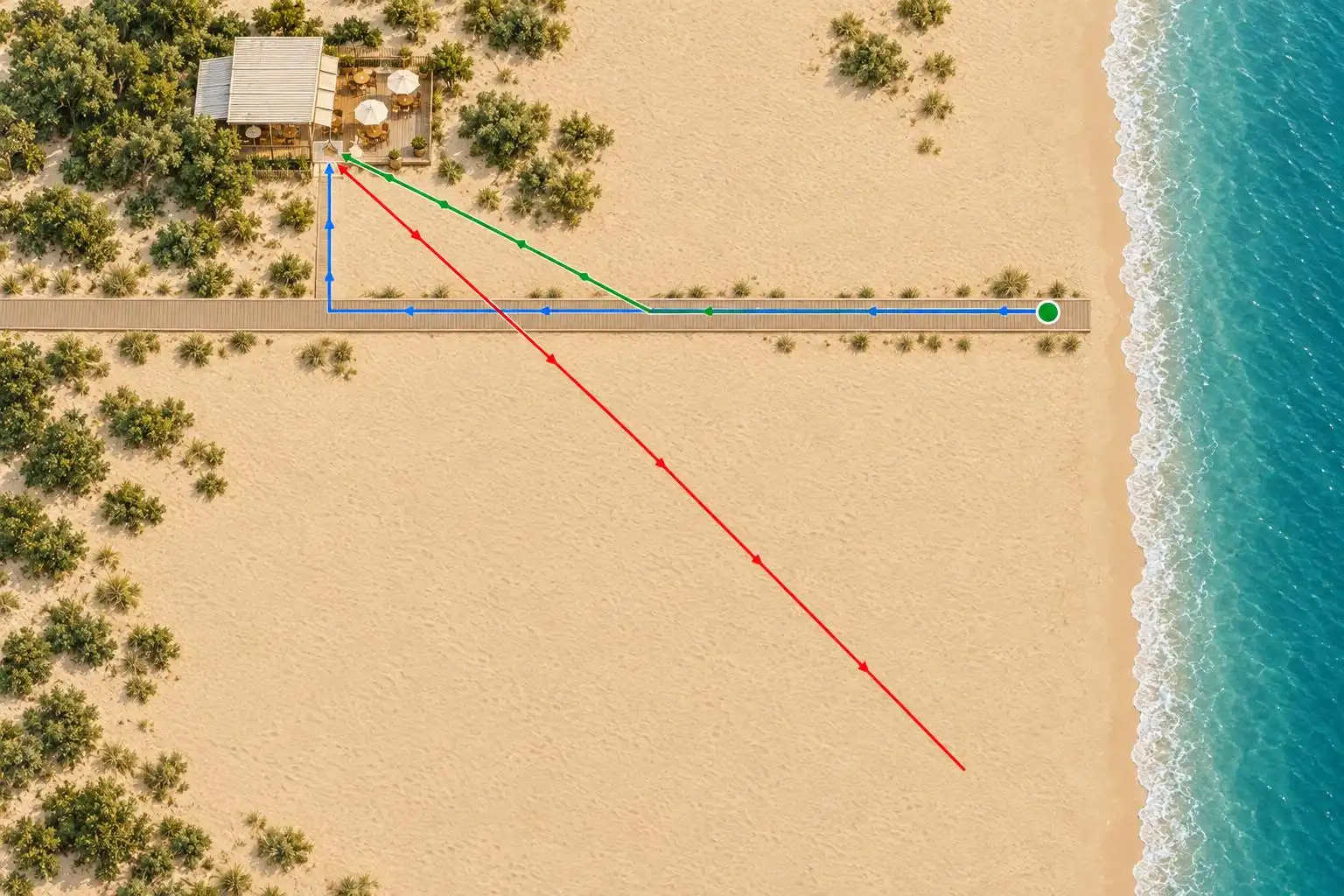
Suppose the café is 4 kilometers east and 3 kilometers inland from your starting point. You can walk at 10 kilometers per hour on the boardwalk but only 5 kilometers per hour on the sand.
If you head straight across the sand, you travel 5 kilometers: the 4-kilometer and 3-kilometer sides form a right triangle, so the direct distance is √(4² + 3²) = 5 kilometers. At 5 kilometers per hour, that takes exactly one hour.
What if you stay on the boardwalk until you are directly opposite the café? You walk 4 kilometers on the boardwalk, taking 4 ÷ 10 = 0.4 hours. Then you walk 3 kilometers inland, taking 3 ÷ 5 = 0.6 hours. That also totals one hour. Neither obvious route has gained you anything.
Give the turning point a name
Let x be the number of kilometers you walk along the boardwalk before turning onto the sand. You then have 4 − x kilometers to cover eastward and 3 kilometers to cover inland. Your sandy stretch is the diagonal of that right triangle, with length √((4 − x)² + 3²).
Time is distance divided by speed, so your total travel time, in hours, is:
T(x) = x/10 + √((4 − x)² + 9)/5.
The first part is boardwalk time; the second is sand time. For example, turning after 2 kilometers gives T(2) = 2/10 + √13/5, or about 0.921 hours—roughly 55.3 minutes. That already beats either one-hour route. Can you do a little better?
Find the point where another step stops helping
Imagine moving your turning point a tiny bit farther along the boardwalk. You add boardwalk distance, which costs time. But you also shorten the sandy diagonal, which saves time. The best turning point is where those two effects balance.
The derivative of T(x) measures how much the time changes when x changes slightly. Here it is:
T′(x) = 1/10 − (4 − x)/(5√((4 − x)² + 9)).
The 1/10 is the time added per extra kilometer of boardwalk. The fraction being subtracted is the time saved on sand. Set the derivative to zero to find where an extra bit of boardwalk neither helps nor hurts:
(4 − x)/√((4 − x)² + 9) = 1/2.
There is a geometric way to read this equation. On the left is the eastward portion of the sandy route divided by its full length. At the fastest turning point, that fraction equals the sand speed divided by the boardwalk speed: 5/10, or one-half.
What the answer looks like on the beach
Solving the equation gives 4 − x = √3, so x = 4 − √3 ≈ 2.27 kilometers. You should stay on the boardwalk for about 2.27 kilometers, then cut diagonally across the sand.
That leaves a sandy stretch of √((√3)² + 3²) = √12 ≈ 3.46 kilometers. The boardwalk takes about 13.6 minutes, and the sand takes about 41.6 minutes. Total: 55.2 minutes, nearly five minutes faster than either obvious route.
Why does the balance produce the fastest time rather than the slowest? Before that turning point, the sand time saved by going a little farther exceeds the boardwalk time added. After it, the extra boardwalk costs more time than it saves. The direction of the trade-off flips there.
A shortcut you can use without calculus
Whenever a trip crosses surfaces with different speeds, resist the urge to minimize distance alone. Break the route into pieces, divide each piece’s distance by its speed, and add the times. A longer route can win if enough of it lies on the faster surface.
The same reasoning applies to a paved path through a park, a road beside a field, or a boat crossing water with different travel speeds. The useful question is not “Which route looks shortest?” It is “Where should I leave the fast part so that one more step on it would no longer pay for itself?”


Leave a Reply
You must be logged in to post a comment.