
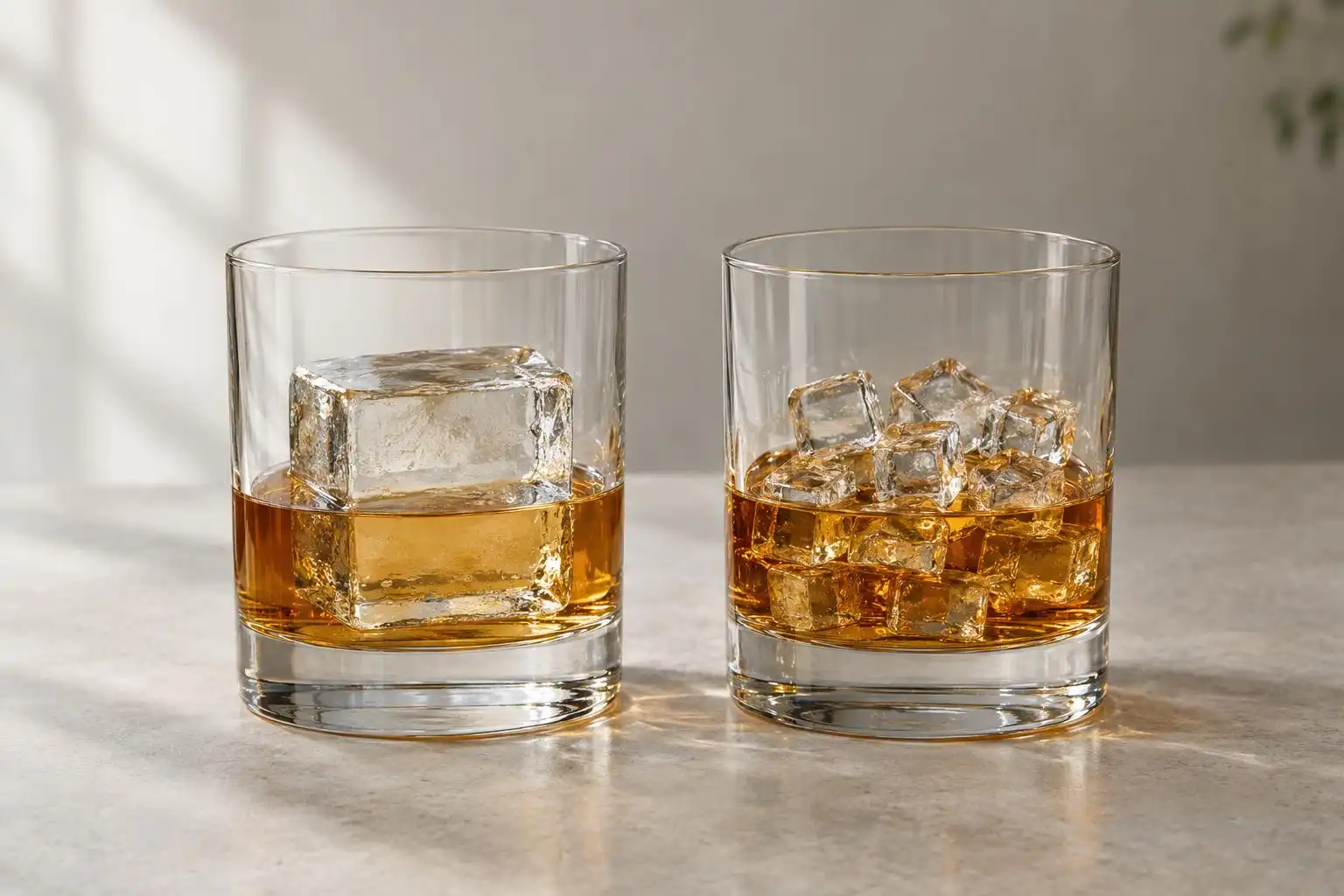

A single large ice cube can make a drink look elegant. It also tends to last longer than the same amount of ice divided into small cubes. The reason is a piece of geometry you can use far beyond the kitchen: when you change an object’s size, its surface and its contents do not change at the same rate.
Same ice, different arrangement
Imagine a cube of ice measuring 4 centimeters along each edge. Its volume is 4 × 4 × 4 = 64 cubic centimeters. Now cut it into eight cubes, each measuring 2 centimeters along each edge. Each small cube has a volume of 2 × 2 × 2 = 8 cubic centimeters; eight of them still total 64.
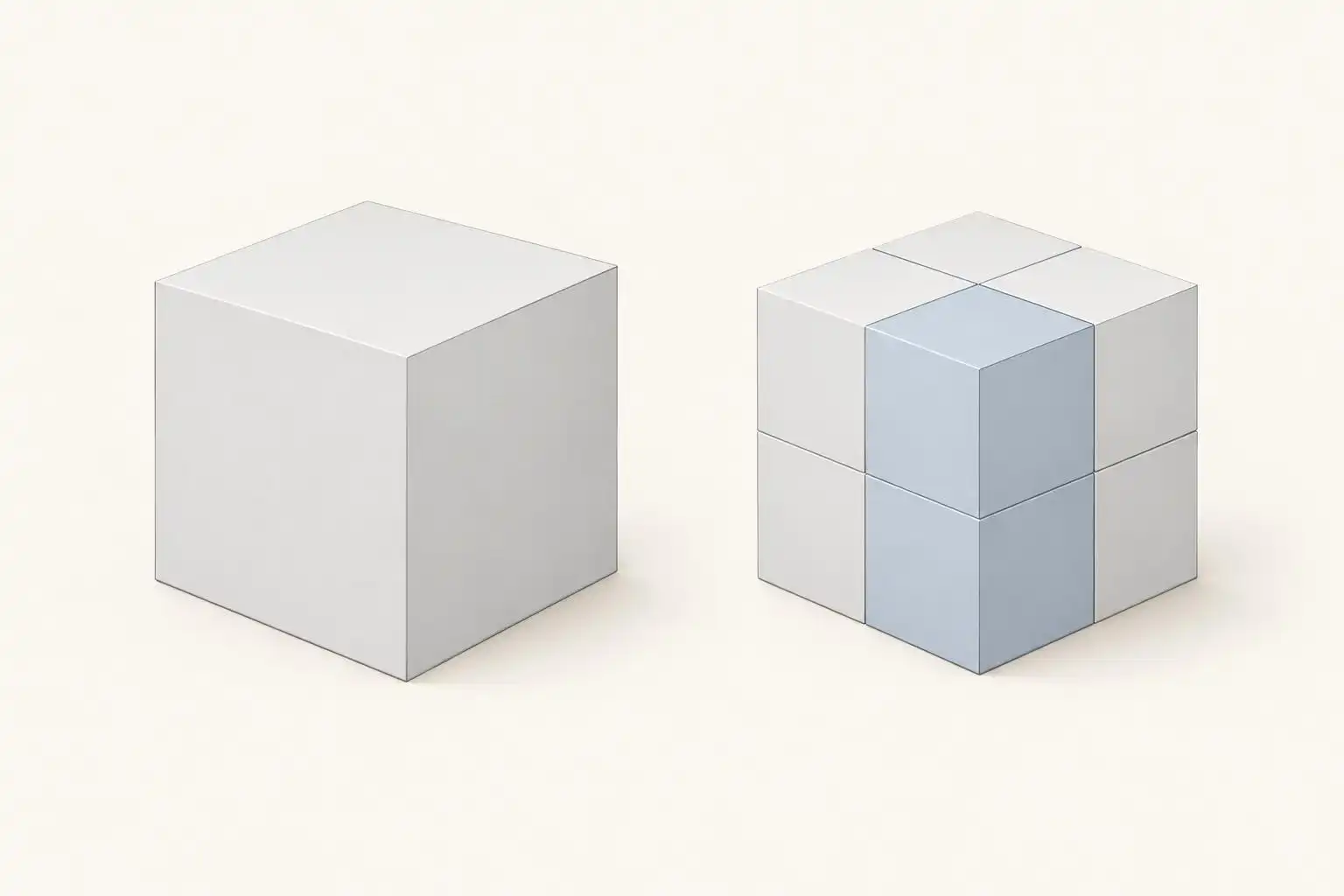
You have not added any ice. You have only exposed surfaces that used to be hidden inside the big cube.
To find the exposed area, count the six square faces on each cube. One 4-centimeter cube has 6 × 4² = 96 square centimeters of surface. A 2-centimeter cube has 6 × 2² = 24 square centimeters. Eight small cubes therefore have 8 × 24 = 192 square centimeters of surface—twice as much as the single big cube.
Why the extra surface matters
Heat enters ice through its surface. In a drink, most of that heat comes from the surrounding liquid; some can also come from the air. If every square centimeter received heat at the same rate, the eight small cubes would initially take in heat about twice as fast as the large one.
Melting requires energy. Ice absorbs that energy as it turns into water, so the extra surface gives heat more places to enter at once. The smaller cubes can cool a drink faster at first, but they also tend to disappear faster. The large cube trades speed for staying power.
There is an important distinction here: cutting ice does not change its total melting capacity. If both portions start at the same temperature and eventually melt completely, the same mass of ice needs the same amount of energy to melt. Shape changes how quickly that energy arrives, not how much is required.
The size rule behind the trick
Suppose you double every edge of a cube. Each face becomes four times as large, because its area depends on two edge lengths. The cube’s volume becomes eight times as large, because volume depends on three. In shorthand, surface area grows with the square of length, while volume grows with the cube of length.
That means the bigger cube has less surface for each unit of ice inside it. For a cube with edge length L, surface area is 6L² and volume is L³. Divide one by the other and you get 6/L. Double L, and the surface-area-to-volume ratio is halved.
This ratio is the useful mental model. A high ratio gives the surroundings lots of access to a small amount of material. A low ratio puts more material behind each patch of exposed surface.
Does twice the surface mean half the melting time?
In a simplified model, it can. Imagine that heat causes every exposed face to retreat inward at the same steady speed. A 2-centimeter cube has only half as far to shrink before it vanishes as a 4-centimeter cube. Under those conditions, the small cubes finish melting in half the time, even though the eight cubes together contain just as much ice.
A real drink is messier. Ice floats, so its faces meet air and liquid rather than identical surroundings. Meltwater moves, cubes bump together, and heat flows differently as the drink cools. The 192-versus-96 calculation tells us the initial geometric advantage of the small cubes, not an exact melting-time prediction for every glass.
Take the rule beyond your drink
The same reasoning explains why finely chopped ingredients cook or thaw faster than one large piece of the same total size: cutting creates more exposed surface without creating more food. It also explains why a large object can retain heat longer relative to its contents than a small version made of the same material.
When you need a quick estimate, ask two questions: How much material is there? and How much of it touches the surroundings? Volume answers the first; surface area answers the second. One big ice cube and eight small ones contain the same ice, but the surroundings get twice as many square centimeters through which to reach it.


Leave a Reply
You must be logged in to post a comment.