
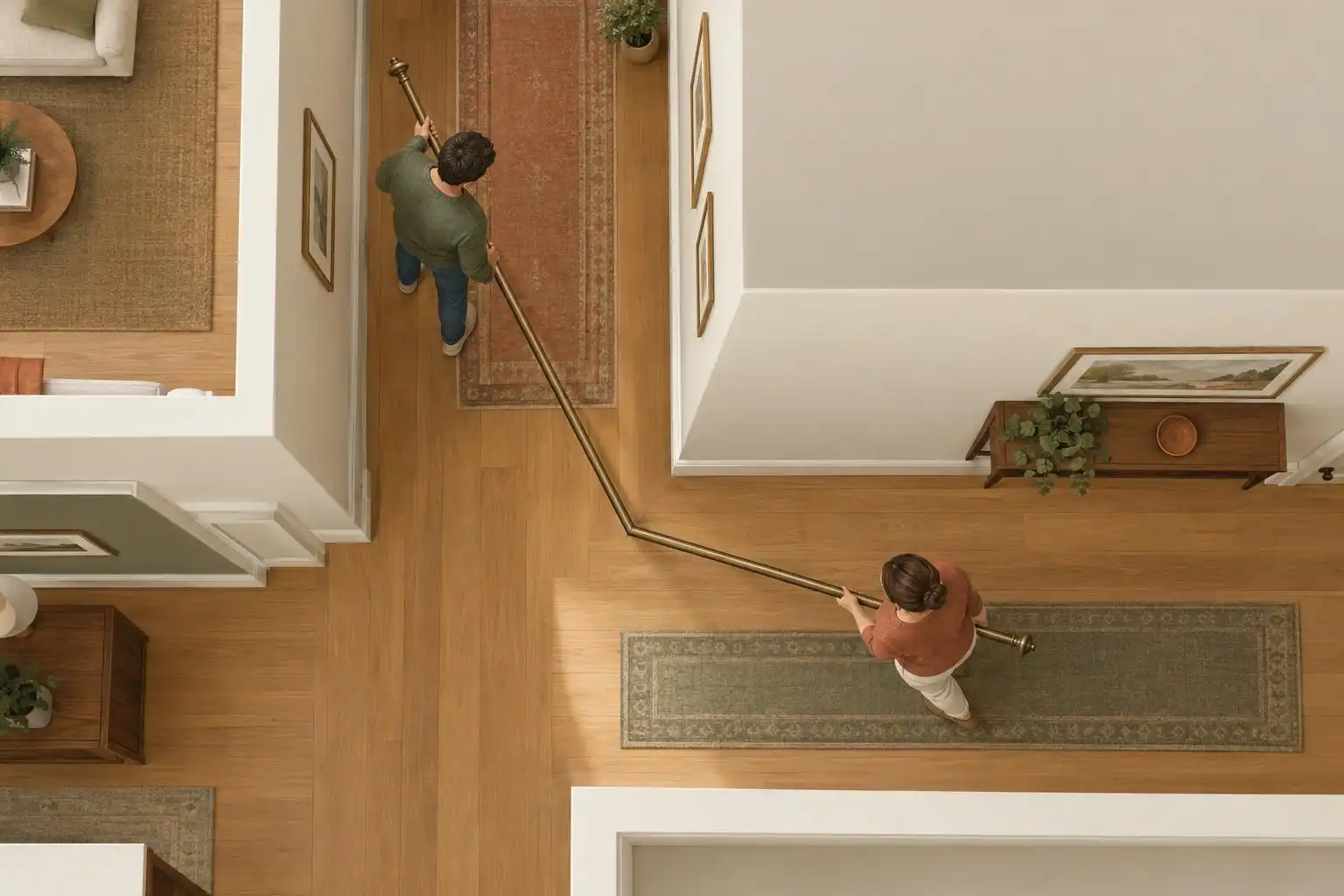

A ten-foot curtain rod fits easily down a four-foot-wide hallway. It also fits down a three-foot-wide hallway. But can you carry it around a right-angle turn between them? The answer depends on the brief moment when the rod occupies both hallways at once.
This is a useful way to think about moving a long object: the difficult part is not necessarily where you start or finish. It is the tightest position along the way.
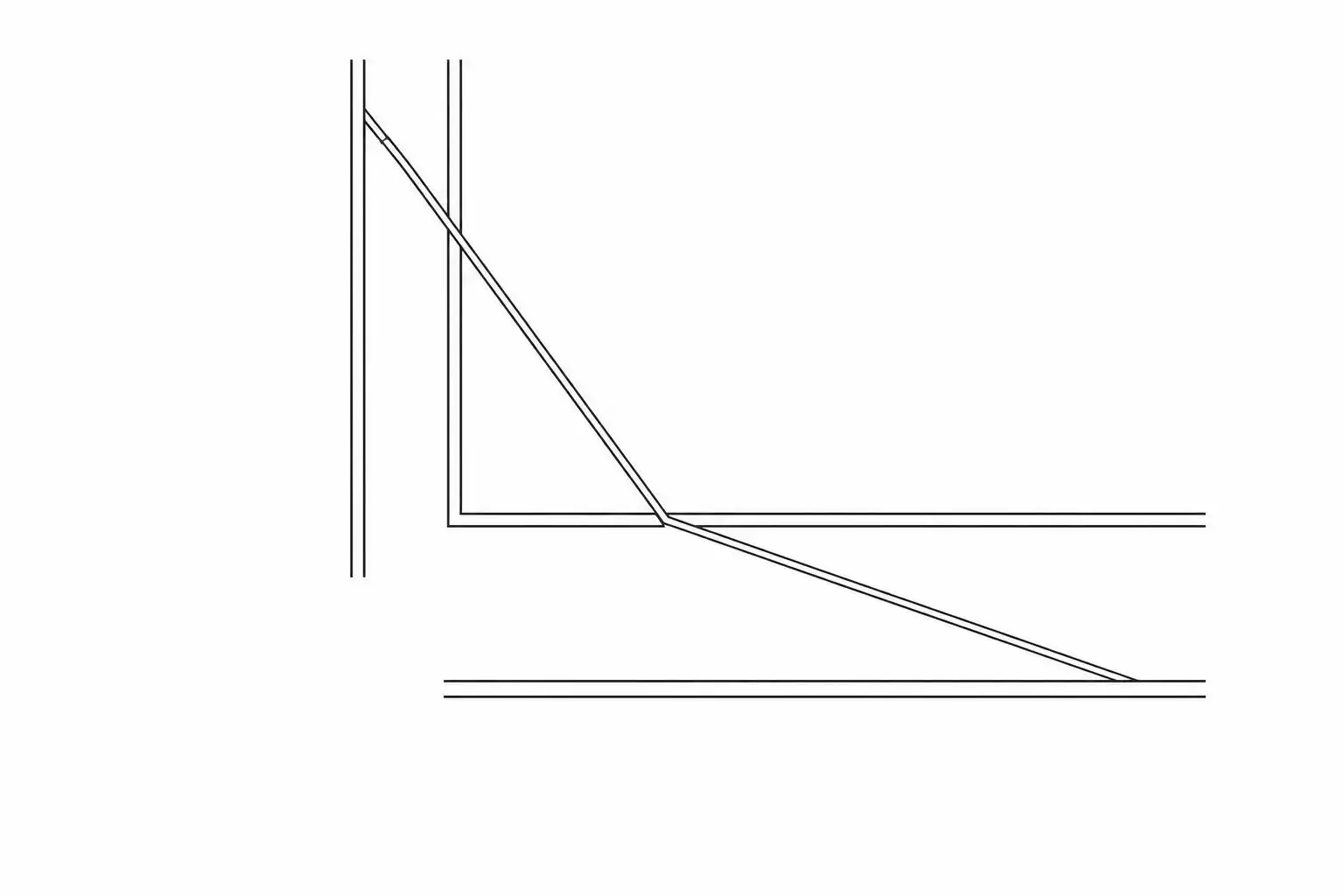
Picture the turn from above
Imagine two straight hallways meeting at a right angle. One is three feet wide; the other is four feet wide. Treat the rod as a perfectly thin, rigid line held level. We will ignore doors, ceiling height, and the possibility of tilting it upward.
As you rotate the rod around the inside corner, part of it reaches into each hallway. At any chosen angle, the walls limit how long those two parts can be. Add their lengths, and you have the longest rod that could occupy that particular position.
The rod must pass through every angle between the two hallways. If it is too long for even one position, it gets stuck.
Turn hallway width into rod length
Call the widths of the hallways a and b. Let θ (theta) be the angle the rod makes with the direction of the first hallway. A right triangle in that hallway has width a across from angle θ and a length of rod along its sloping side.
The sine of an angle is the opposite side of a right triangle divided by its sloping side. So the available rod length in the first hallway is a/sin θ. In the second hallway, the corresponding angle is 90° − θ. Its available length is b/cos θ, because the sine of 90° − θ equals the cosine of θ.
Together, the two hallways allow a rod of at most
L(θ) = a/sin θ + b/cos θ
at that angle. Notice that this limit changes as the rod turns. Near one end of the turn, one term is large; near the other end, the other term is large. Somewhere between, their sum reaches its lowest value. That is the bottleneck.
Try the numbers before finding the exact answer
For a three-foot hallway meeting a four-foot hallway, consider a 45° position. Both sine and cosine are about 0.707, so the available length is
L(45°) ≈ 3/0.707 + 4/0.707 ≈ 9.90 feet.
That calculation tells us something definite: a ten-foot rod cannot make the turn, because it will not fit at 45°. But it does not prove that a 9.9-foot rod can make it. Another angle might offer even less room.
In fact, the tightest position is at about 42.4°. There, the first hallway accommodates roughly 4.45 feet of rod and the second about 5.42 feet: a total of about 9.87 feet. Under our thin, level-rod assumptions, a nine-foot rod can pass; a ten-foot rod cannot.
Find the tightest angle
To find the bottleneck without trying angles one by one, we look for where a tiny change in angle stops decreasing L and starts increasing it. Calculus expresses that turning point by setting the derivative—the rate at which L changes with θ—to zero.
Differentiating a/sin θ + b/cos θ and rearranging gives b sin³ θ = a cos³ θ. Dividing by b cos³ θ leaves a compact rule:
tan³ θ = a/b.
For our hallways, tan³ θ = 3/4, which gives θ ≈ 42.4°. Substituting that angle into L(θ) produces the 9.87-foot limit. The angle is not 45° because the hallways have different widths: the rod must spend a little more of the turn aligned with the wider one.
There is also a direct formula for the maximum rod length that can make a right-angle turn:
Maximum length = (a^(2/3) + b^(2/3))^(3/2).
With a = 3 and b = 4, this gives approximately 9.87 feet. For equal-width hallways, the formula simplifies: if each hallway is three feet wide, the limit is 3√8 ≈ 8.49 feet.
What the calculation can—and cannot—tell you
A real couch is not a thin line. Its depth, arms, packaging, and any protruding corners consume clearance, while tilting it or carrying it through a doorway might create options our flat diagram does not allow. Measure the object’s full dimensions and the actual route before treating this formula as a moving-day verdict.
The transferable idea is simpler than the formula: check the narrowest configuration, not just the narrowest hallway. A long object may fit comfortably at both ends of a journey and still fail at the turn between them.


Leave a Reply
You must be logged in to post a comment.