

Suppose a shop sells mystery packs containing one of ten different stickers. You want the complete set, and every sticker is equally likely to appear in each pack. Ten packs sounds like a reasonable shopping list—until you remember that the packs can contain duplicates. How many should you actually expect to buy?
Every New Sticker Changes the Odds
Your first pack is guaranteed to contain a sticker you need. After that, the odds depend on how many different stickers you already own. If you have one, nine of the ten possible stickers would be new, so your next pack has a 9-in-10 chance of helping. If you have nine, only one would be new. Your chance has fallen to 1 in 10.
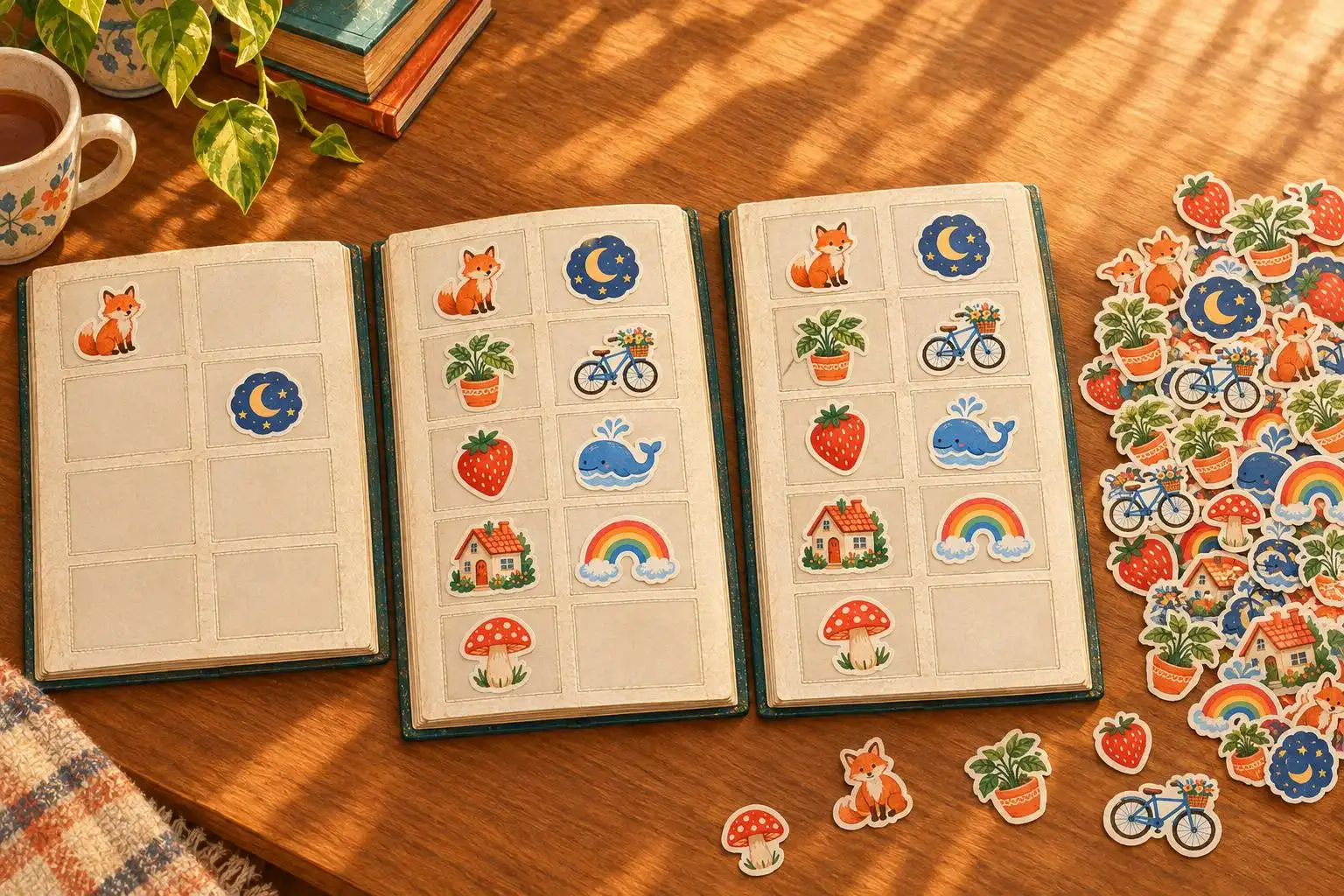
The important shift is to count packs until the next new sticker, rather than packs in total. Early in the collection, that wait is short. Near the end, duplicates become the rule rather than the exception.
Turning a Chance Into an Average Wait
If each pack has a 1-in-10 chance of giving you the sticker you need, you might expect to wait ten packs for it. That is not a guarantee: you could get lucky on the next pack or still be searching after twenty. It is an average over many attempts to complete the same collection.
Here is why the calculation works. Call the average number of packs until success E, and call the chance of success on each pack p. You buy one pack. If it fails, which happens with chance 1 − p, you are back where you started and still expect to buy E more packs. So E = 1 + (1 − p)E. Rearranging gives E = 1/p.
When you own eight different stickers, two of the ten possibilities are new. Your chance of progress is 2/10, so the average wait for the ninth distinct sticker is 10/2, or five packs. Once you own nine, the average wait for the tenth is ten packs.
The Price of a Complete Set
We can now add the expected waits at each stage. The first sticker takes one pack on average. Then the second takes 10/9 packs, because nine kinds remain useful. The third takes 10/8, and so on, until the tenth takes 10/1.
For this ten-sticker set, the total is 10/10 + 10/9 + 10/8 + … + 10/1, or about 29.3 packs. At $3 per pack, that is an average spend of about $88, not $30. You will never buy a fraction of a pack; 29.3 is the average across many attempts.
The slowdown is especially stark at the finish. Getting your first five distinct stickers takes about 6.5 packs on average. Getting the remaining five takes about 22.8 more. The final sticker alone accounts for ten of those packs.
An Average Is Not a Promise
Would buying 30 packs give you a complete set? Possibly, but the 29.3-pack average does not tell you how often that happens. Some collectors finish early, while unlucky ones keep opening duplicates long after pack 30.
We can get a useful safety estimate by looking at one sticker at a time. A particular sticker has a 9-in-10 chance of not appearing in any given pack. Its chance of being absent after 44 independent packs is (9/10)^44, about 0.0097. Across all ten stickers, the average number still missing after 44 packs is ten times that, or about 0.097.
That gives us a bound: if a set is incomplete, at least one sticker must be missing. So the chance that any sticker is missing cannot exceed 0.097. Buying 44 packs gives you at least a 90% chance of completing the set under our equal-odds assumptions. It could give you a slightly better chance; this calculation deliberately errs on the cautious side.
When to Stop Opening Packs
The mystery-pack model assumes independent packs and equally common stickers. Real collections may have rare designs or guarantees against duplicates, either of which changes the numbers. But the central lesson survives: as the number of things you still need shrinks, the value of another random draw shrinks with it.
That is why trading becomes so powerful near the end. If you need one sticker, a swap for that sticker succeeds where a random $3 pack has only a 1-in-10 chance. Whenever you are trying to complete a collection, ask how many possible outcomes would still help you. That fraction tells you both your chance of progress on the next try and, by flipping it, your average wait.


Leave a Reply
You must be logged in to post a comment.