
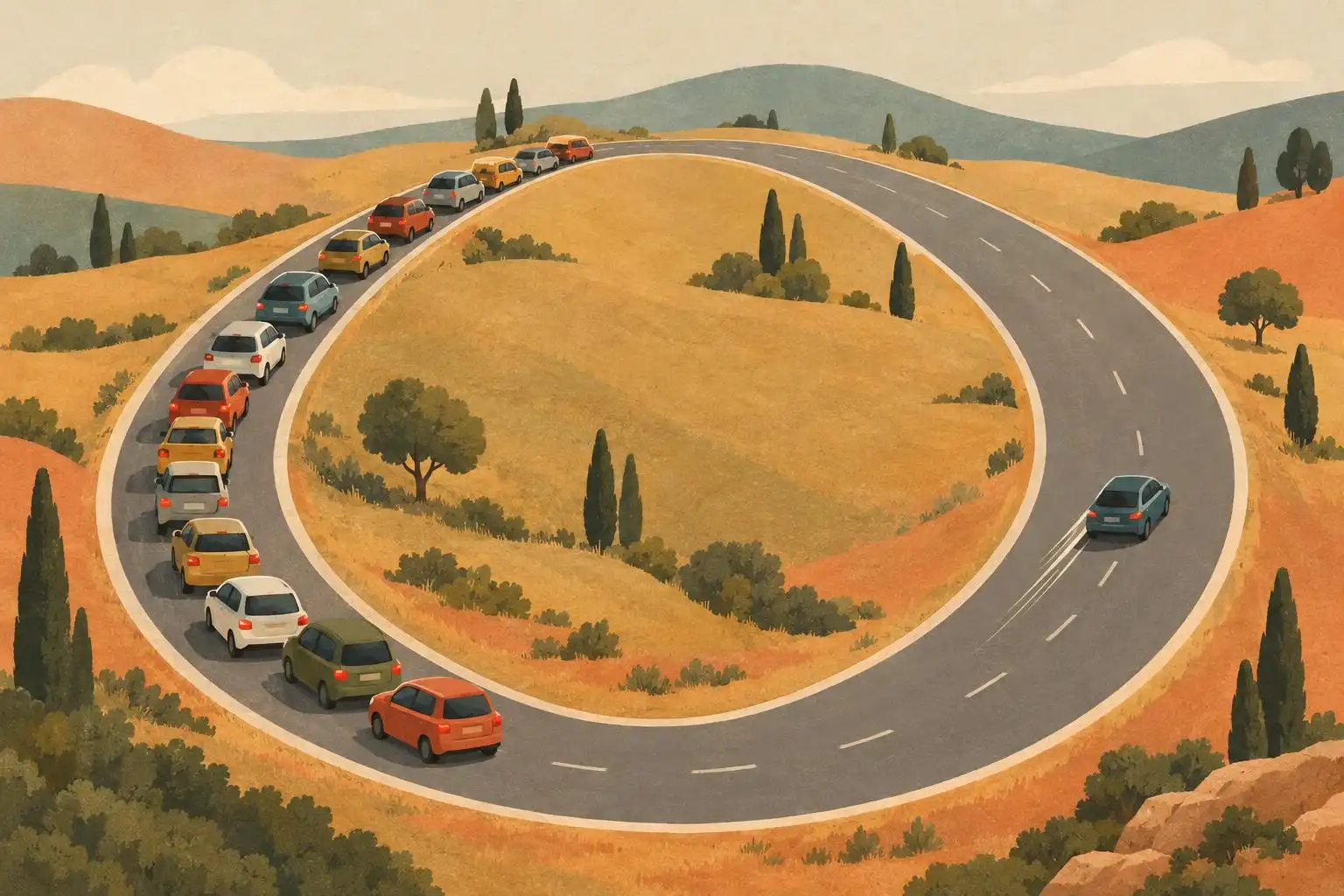

Suppose you drive 60 miles to visit a friend at 30 miles per hour, then take the same road home at 60 miles per hour. What was your average speed for the whole trip?
The tempting answer is 45 miles per hour, halfway between 30 and 60. But the actual answer is 40. The difference comes down to something easy to overlook: you spend much more time driving slowly than driving quickly.
Start with the clock, not the speeds
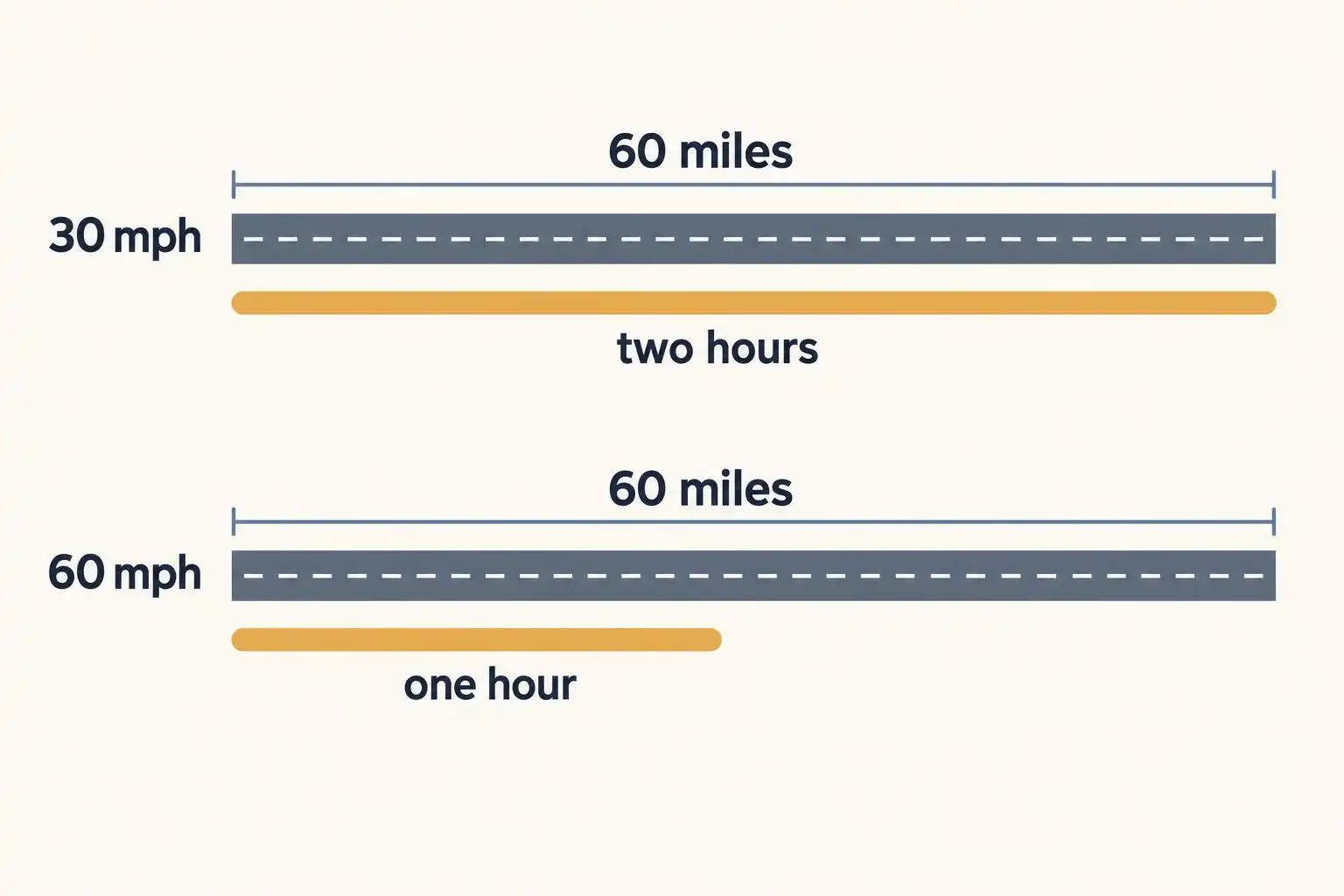
Average speed means total distance divided by total time. The outward journey takes 60 ÷ 30 = 2 hours. The return takes 60 ÷ 60 = 1 hour. You cover 120 miles in 3 hours, so your average speed is 120 ÷ 3 = 40 miles per hour.
Averaging the two speedometer readings gives each one equal weight. But the slow speed occupies two hours of your trip, while the fast speed occupies only one. To find an average speed, you have to account for how long each speed lasted.
Why the faster leg cannot simply cancel the slower one
Imagine making the return trip faster and faster. At 120 miles per hour, it would take half an hour; at 600 miles per hour, just six minutes. Yet the outward journey would still take two hours. Even if you could get home in no time at all, you would have traveled 120 miles in at least two hours. Your round-trip average could approach 60 miles per hour, but never exceed it.
That is a useful check on any proposed answer. Once the slow leg has used up two hours, the fast leg can shorten only the time that remains. Doubling your speed does not give you back the hours you have already spent.
The shortcut for equal-distance trips
When the two legs cover the same distance, there is a compact formula. Call the two speeds a and b. If each leg is d miles long, the total distance is 2d, while the total time is d/a + d/b. Divide distance by time, then cancel d, and you get:
Average speed = 2ab ÷ (a + b)
For our trip, that is 2 × 30 × 60 ÷ (30 + 60) = 40 miles per hour. This kind of average is called the harmonic mean. The name matters less than the reason it works: for a fixed distance, time is distance divided by speed.
The ordinary halfway average, (a + b) ÷ 2, answers a different question. It works if you spend equal amounts of time at each speed. Drive for one hour at 30 miles per hour and one hour at 60, and you cover 90 miles in two hours: an average of 45 miles per hour. This time, though, the faster stretch is twice as long as the slower one.
When the distances differ
Real routes rarely split into equal-length legs, so the most reliable method is still to calculate the time for each stretch. Say a delivery driver travels 10 miles through town at 20 miles per hour, then 30 miles on a highway at 40 miles per hour.
The town stretch takes 10 ÷ 20 = 0.5 hour. The highway stretch takes 30 ÷ 40 = 0.75 hour. That is 40 miles in 1.25 hours, for an average of 32 miles per hour. Neither the simple average of the speeds, 30, nor an average weighted by distance, 35, gives the right answer. The clock settles it.
A rule you can use on any journey
Whenever a trip has several speeds, write down how far you go at each one, divide each distance by its speed, and add those times. Then divide the total distance by the total time. It works for a two-leg drive, a cycling route with a headwind, or an estimated arrival time across city streets and highways.
The mental model is simple: speeds do not add up to a journey; distances and times do. If you are trying to make up for a delay, calculate the minutes a faster stretch can actually save. That will tell you far more than averaging the numbers on the speedometer.


Leave a Reply
You must be logged in to post a comment.