
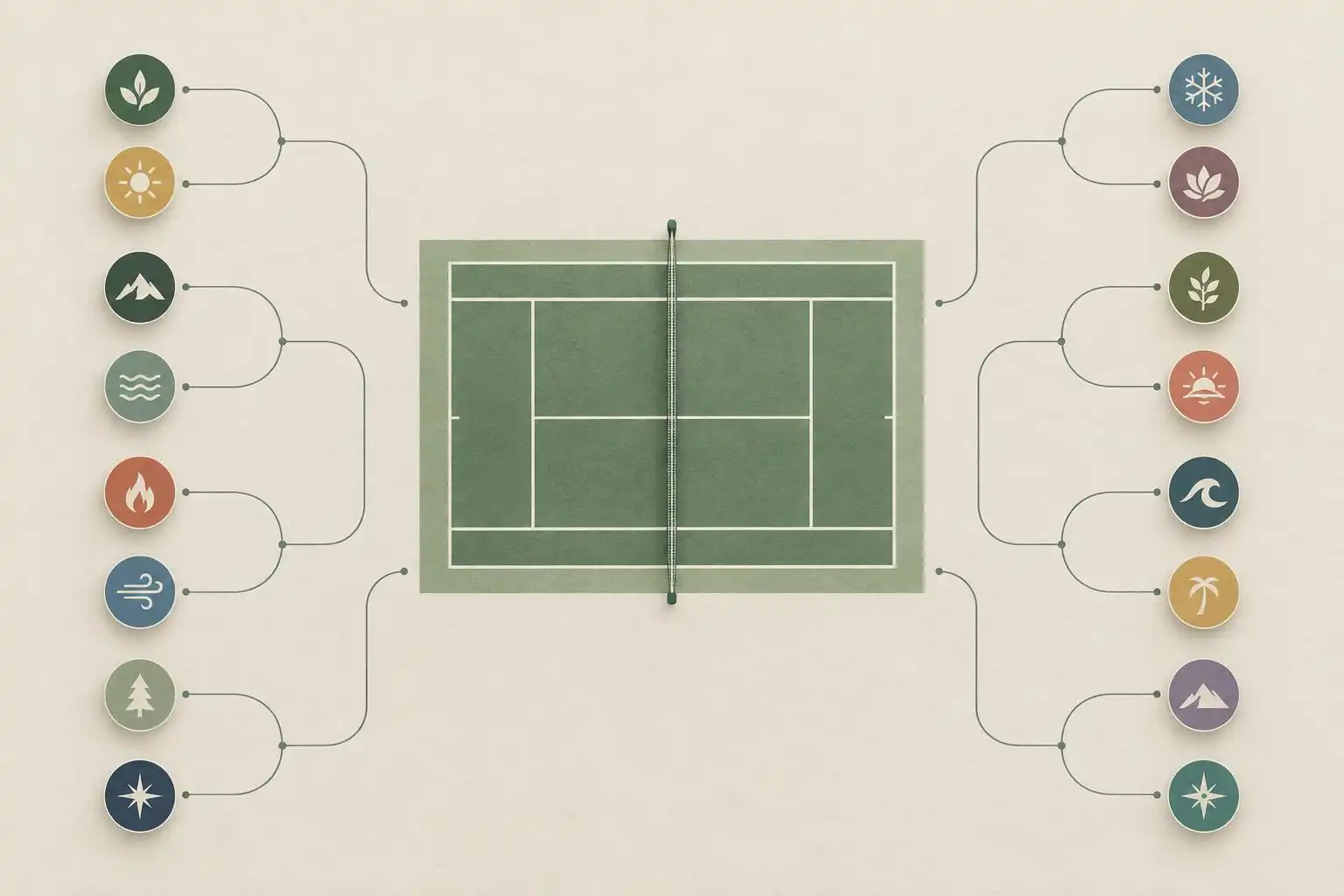

Suppose you’re organizing a tournament for 16 teams. You want every team to face every other team exactly once. How many games should you book? If your first instinct is “a lot,” you’re right—but there’s a neat way to get the exact number without writing out the whole schedule.
Count opponents, then correct the count
Each team has 15 possible opponents. With 16 teams, that gives 16 × 15 = 240. But 240 is not the number of games: it counts every matchup twice. When the Falcons play the Bears, that’s one game on the Falcons’ list and the same game on the Bears’ list.
Divide by two to correct the double count: 16 × 15 ÷ 2 = 120 games. More generally, if there are n teams and each pair meets once, the number of games is n × (n − 1) ÷ 2. The expression n − 1 is simply the number of opponents available to each team.
You can check the rule on a smaller tournament. Four teams each have three opponents, so 4 × 3 ÷ 2 = 6 games. Write out the matchups—A–B, A–C, A–D, B–C, B–D, and C–D—and there are indeed six.
Draw the tournament as a network
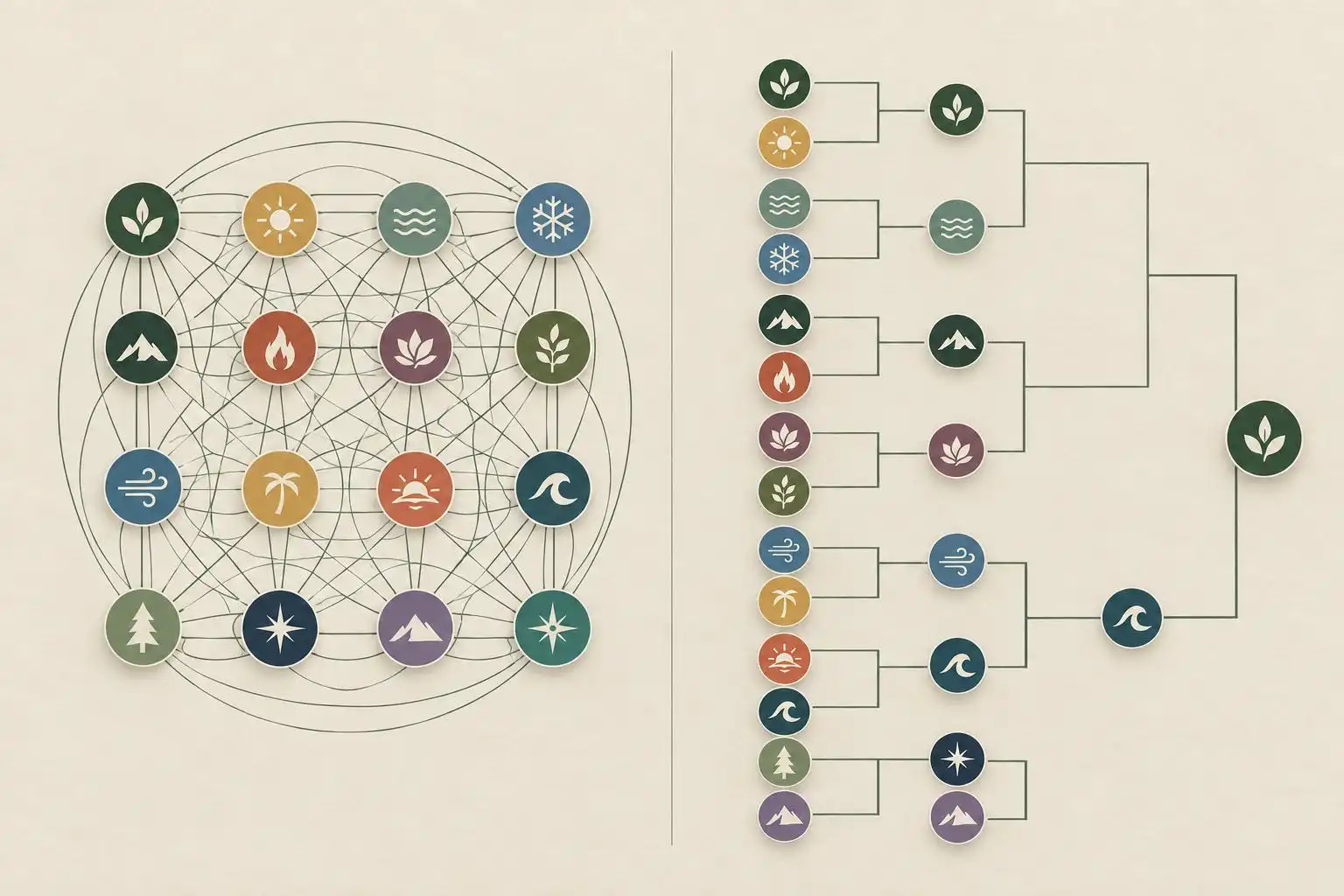
Imagine each team as a dot and each game as a line connecting two dots. Mathematicians call this kind of picture a graph: the dots are vertices, and the lines are edges. For a tournament where everyone meets everyone, every pair of dots gets a line. That’s a complete graph.
The picture explains the division by two. At each dot, you can count 15 lines reaching other dots. Add those counts across all 16 dots and you get 240. Yet every line has two ends, so it appears in two dot-counts. The network contains 120 distinct lines—and the tournament needs 120 distinct games.
This viewpoint works well beyond sports. If 16 people all shake hands once, there are 120 handshakes. If every one of 16 offices needs a direct communication link to every other office, there are 120 links. In each case, you’re counting pairs, not individual participants.
Games are not the same as rounds
Knowing the total games doesn’t yet tell you how long the tournament takes. If all teams can play at once, a round can hold eight games: 16 teams, paired off. Divide 120 games by eight and you get 15 rounds. Each team plays one game per round and meets all 15 opponents.
That schedule is achievable, not merely a hopeful calculation. Picture 16 positions around a table. Keep one team fixed, rotate the other 15 teams one position between rounds, and pair teams in facing positions. After 15 rounds, every pair has met once. This is often called the circle method.
Real schedules may take longer. A league might have too few venues for eight simultaneous games, or teams might need rest days and travel time. Those constraints change the calendar, but they do not change the underlying count of 120 matchups.
Why knockout tournaments are so much shorter
Now change the rules: a team leaves the tournament after its first loss. To find one champion from 16 teams, you must eliminate 15 teams. Every game eliminates exactly one team, so a single-elimination tournament needs 15 games.
That’s a striking difference: 15 games for a knockout, compared with 120 for everyone to meet everyone. The knockout can fit into four rounds, with 8 games in the first round, then 4, then 2, then a final. But most pairs of teams never play each other. A first-round loss gives you only one game of evidence about that team.
An organizer could choose a middle ground: split the 16 teams into four groups of four, have each team play the other three in its group, then let the four group winners enter semifinals and a final. Each group needs 4 × 3 ÷ 2 = 6 games, so group play takes 24. Add three knockout games, and the event takes 27 games. That count assumes one game per pairing and no third-place match.
The question to ask before counting
Tournament size alone doesn’t determine the schedule. The crucial question is what a game is meant to accomplish. If every pair must meet, count pairs. If each game removes one contender, count the eliminations needed to leave a winner.
That distinction is a useful back-of-the-envelope tool whenever you plan a competition—or a meeting, interview schedule, or network of connections. First decide which pairs actually need to meet. Then count them. The arithmetic is easy once the rule is clear.


Leave a Reply
You must be logged in to post a comment.