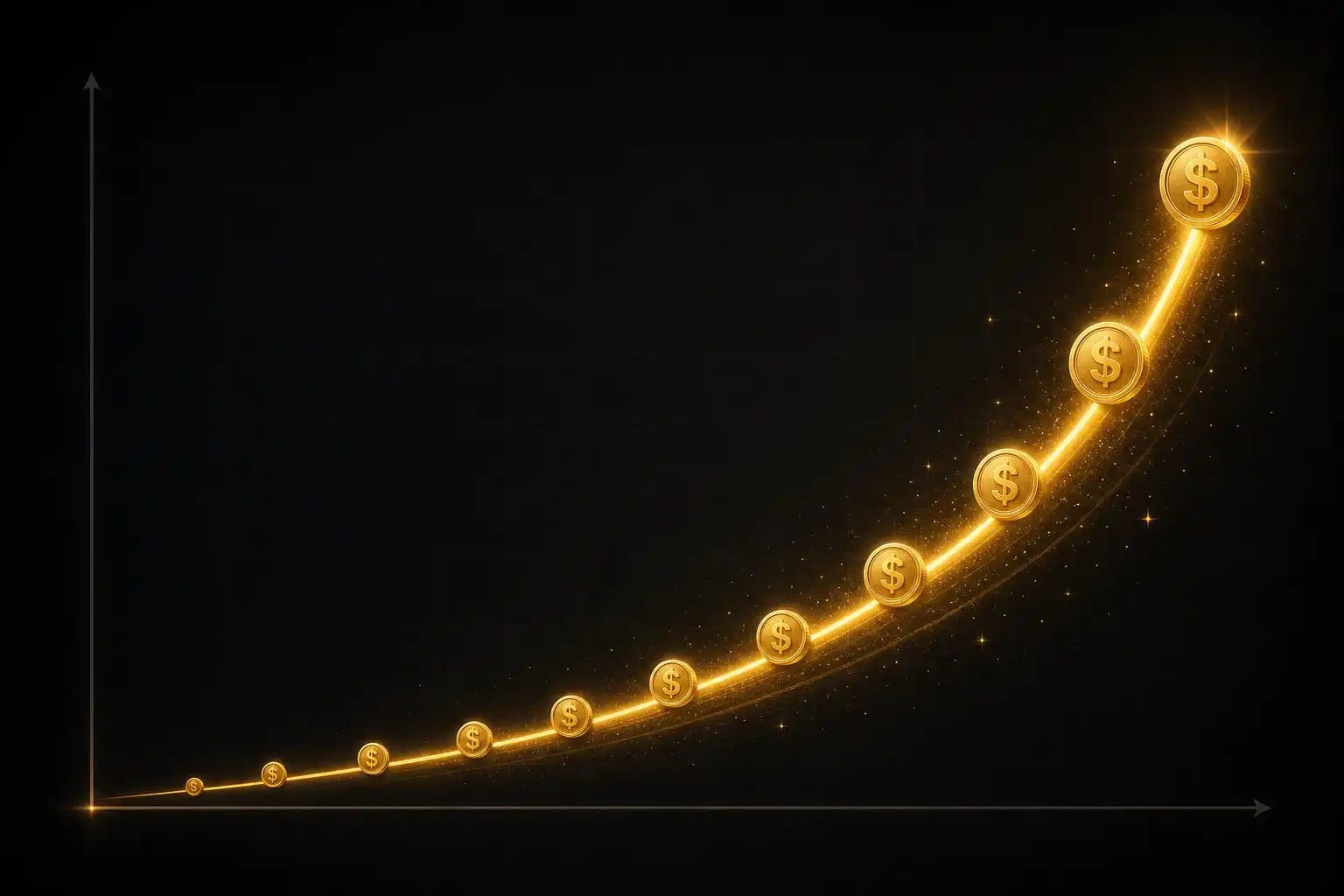

Imagine you put $1,000 in a savings account that pays 8% interest per year. After one year, you have $1,080. Simple enough. But here’s where things get interesting — and where most people’s intuition quietly breaks down.
If you leave that money alone, you don’t just keep adding $80 every year. The interest starts earning interest. After two years you have $1,166.40, not $1,160. After ten years you have $2,158.93, not $1,800. After thirty years? $10,062.66 — more than ten times your original deposit, from a single untouched investment.
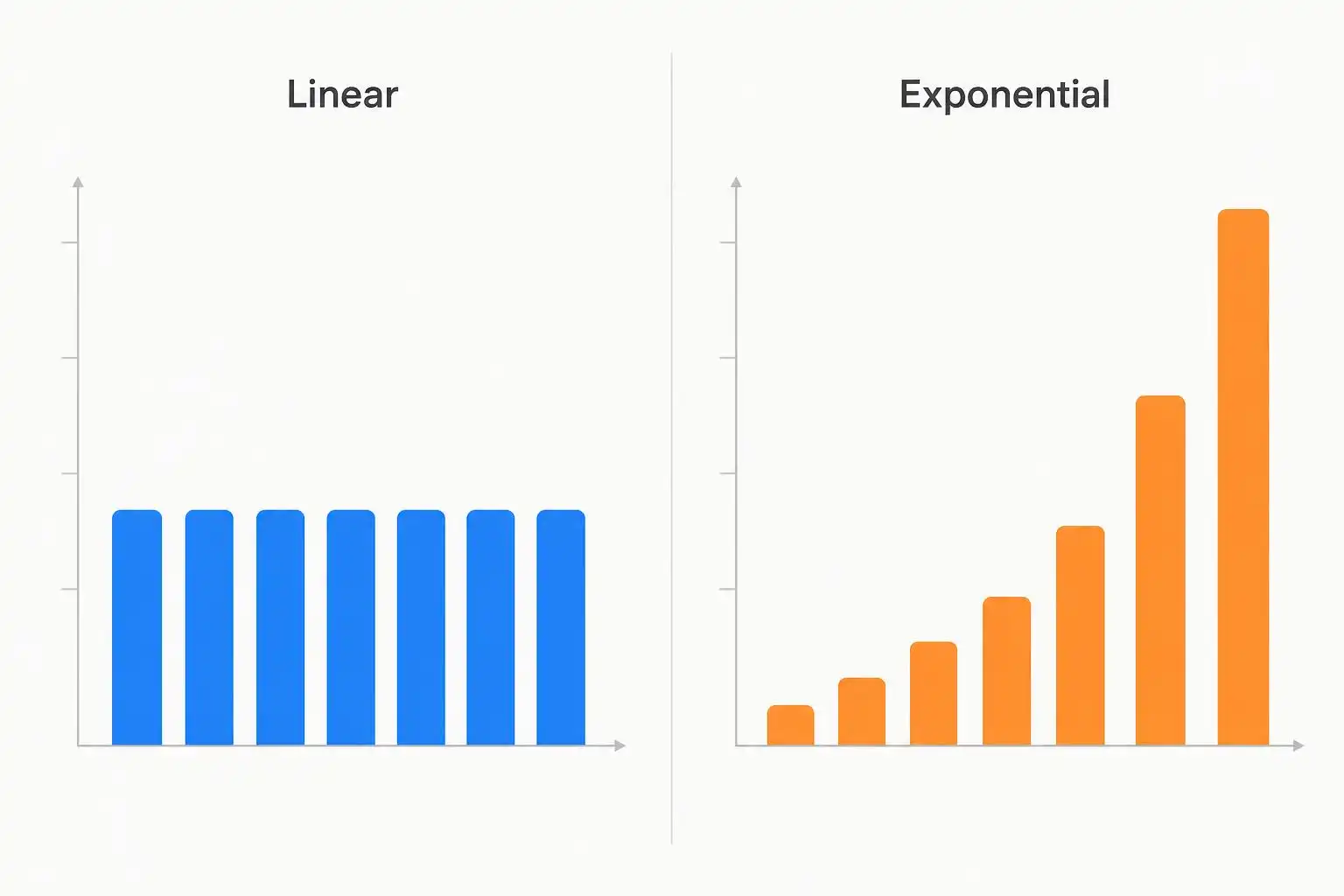
That gap between what your gut expects and what actually happens is the signature of exponential growth, and understanding it is one of the most practically powerful things mathematics can hand you.
Starting Simple: What “Percent” Actually Means
Before we build the full picture, let’s be precise about the word percent. “Per cent” literally means “per hundred.” So 8% is just the fraction 8/100, or 0.08. When we say an account grows by 8%, we mean every dollar becomes 1 + 0.08 = 1.08 dollars after one year.
That multiplier — 1.08 — is the engine of the whole story. Let’s call it the growth factor.
Year by Year: Building the Pattern
Start with a principal (the initial amount) of $1,000. Each year, you multiply by the growth factor:
- Year 0: $1,000
- Year 1: $1,000 × 1.08 = $1,080
- Year 2: $1,080 × 1.08 = $1,166.40
- Year 3: $1,166.40 × 1.08 = $1,259.71
- …
Notice what’s happening. Each step multiplies by 1.08 again. After n years, you’ve multiplied by 1.08 a total of n times. Mathematically, that’s:
A = P × (1 + r)ⁿ
Where:
- A is the final amount
- P is the principal ($1,000)
- r is the annual interest rate as a decimal (0.08)
- n is the number of years
This is the compound interest formula, and it is a close relative of the most important equation in all of applied mathematics: the exponential function.
Let’s verify our 30-year result: A = 1000 × (1.08)³⁰. Now, (1.08)³⁰ ≈ 10.0627, so A ≈ $10,062.70. That matches.
Why Exponential Growth Feels So Weird
Human brains evolved to think linearly. If you walk at 5 km/h for 2 hours, you go 10 km. Double the time, double the distance. Linear relationships are everywhere in daily life, and our intuitions are finely tuned to them.
Exponential growth is different. It doesn’t add a fixed amount each step — it multiplies by a fixed factor. The result is a curve that starts out looking almost linear (so we underestimate it early on) and then suddenly rockets upward in a way that shocks us.
Here’s a vivid illustration: fold a piece of paper in half 42 times. Each fold doubles the thickness. A sheet of paper is about 0.1 mm thick. After 42 doublings, you’d have 2⁴² × 0.1 mm ≈ 439,804 km — a little more than the average one-way distance to the Moon.
Nobody believes that the first time they hear it. That disbelief is the lesson.
The Rule of 72: A Back-of-the-Envelope Superpower
Here’s a mental shortcut so useful it deserves its own section.
The Rule of 72: Divide 72 by the annual interest rate (as a percentage) to get the approximate number of years it takes your money to double.
- At 8% per year: 72 ÷ 8 = 9 years to double.
- At 6% per year: 72 ÷ 6 = 12 years to double.
- At 3% per year: 72 ÷ 3 = 24 years to double.
Let’s check the 8% case with the exact formula. We want (1.08)ⁿ = 2. Taking logarithms: n = log(2) / log(1.08) ≈ 0.6931 / 0.07696 ≈ 9.006 years. The Rule of 72 gave us 9. Remarkably accurate.
Why 72? Because ln(2) ≈ 0.693, and for small interest rates r, log(1 + r) ≈ r, so the doubling time is approximately 0.693/r. Multiply top and bottom by 100 to work in percentages and you get 69.3/r%. The number 72 is used instead of 69.3 because it has more integer divisors (it divides evenly by 1, 2, 3, 4, 6, 8, 9, 12…), making mental arithmetic much easier. The small rounding error is worth the convenience.
You can now estimate doubling times in your head for any interest rate, inflation figure, or growth rate you encounter.
Compounding Frequency: When “Per Year” Isn’t the Whole Story
Banks don’t always compound once a year. Some compound monthly, daily, or even continuously. This matters more than you might think.
If an account compounds m times per year at an annual rate r, the formula becomes:
A = P × (1 + r/m)^(m×n)
The annual rate gets divided into m smaller chunks, but those chunks compound m times as often. Let’s compare our $1,000 at 8% over 10 years under different compounding schedules:
| Compounding | Formula | Result |
|---|---|---|
| Annually (m=1) | 1000 × (1.08)¹⁰ | $2,158.93 |
| Monthly (m=12) | 1000 × (1 + 0.08/12)¹²⁰ | $2,219.64 |
| Daily (m=365) | 1000 × (1 + 0.08/365)³⁶⁵⁰ | $2,225.35 |
Monthly compounding earns you about $61 more than annual compounding over a decade. Daily earns you $6 more than monthly. The gains from increasing frequency get smaller and smaller — they’re approaching a limit.
That limit, reached when you compound continuously (infinitely often), is:
A = P × e^(r×n)
Where e ≈ 2.71828 is Euler’s number, arguably the most important constant in mathematics. For our example: A = 1000 × e^(0.08 × 10) = 1000 × e^0.8 ≈ 1000 × 2.2255 = $2,225.54.
The jump from daily to continuous compounding is a mere 19 cents on $1,000 over 10 years. But the formula e^(rt) is far more than a curiosity — it describes radioactive decay, population growth, the cooling of your coffee, and the spread of a rumor. Compound interest is just one face of a universal mathematical pattern.
The Real-World Punchline: Starting Early Beats Earning More
Here’s the insight that the math most urgently wants you to walk away with.
Consider two people:
- Alice invests $5,000/year from age 25 to 35 (10 years), then stops. Total invested: $50,000.
- Bob invests $5,000/year from age 35 to 65 (30 years). Total invested: $150,000.
Both earn 7% annually, and contributions are made at the end of each year. Who has more at age 65?
- Alice: Her first contribution grows for 39 years, and her last contribution (at age 35) grows for 30 years. Working through the math, she ends up with approximately $526,000.
- Bob: He invests three times as much money over three times as many years, but starts later. He ends up with approximately $472,000.
Alice wins — by $54,000 — despite investing a third as much money, purely because she started a decade earlier.
The exponential function rewards time above almost everything else. The growth factor is applied again and again, and each extra year of compounding multiplies everything that came before it. This is why financial advisors sound like a broken record about starting early: the math genuinely is that lopsided.
Carrying This Forward
You now have a small toolkit:
- The compound interest formula A = P(1 + r)ⁿ — the core engine.
- The Rule of 72 — divide 72 by the rate to find doubling time in your head.
- The continuous compounding formula A = Pe^(rt) — the mathematical limit, and a window into one of nature’s deepest patterns.
- The intuition — exponential growth is multiplicative, not additive, and it rewards patience in a way that linear thinking will always underestimate.
The next time you see a headline about an economy “growing at 3% per year” or a virus “doubling every five days,” you’ll have the mental model to know exactly what that means — and to feel, in your bones, why it matters so much more than it sounds.
That’s the gift mathematics keeps giving: not just answers, but a new way of seeing.


Leave a Reply