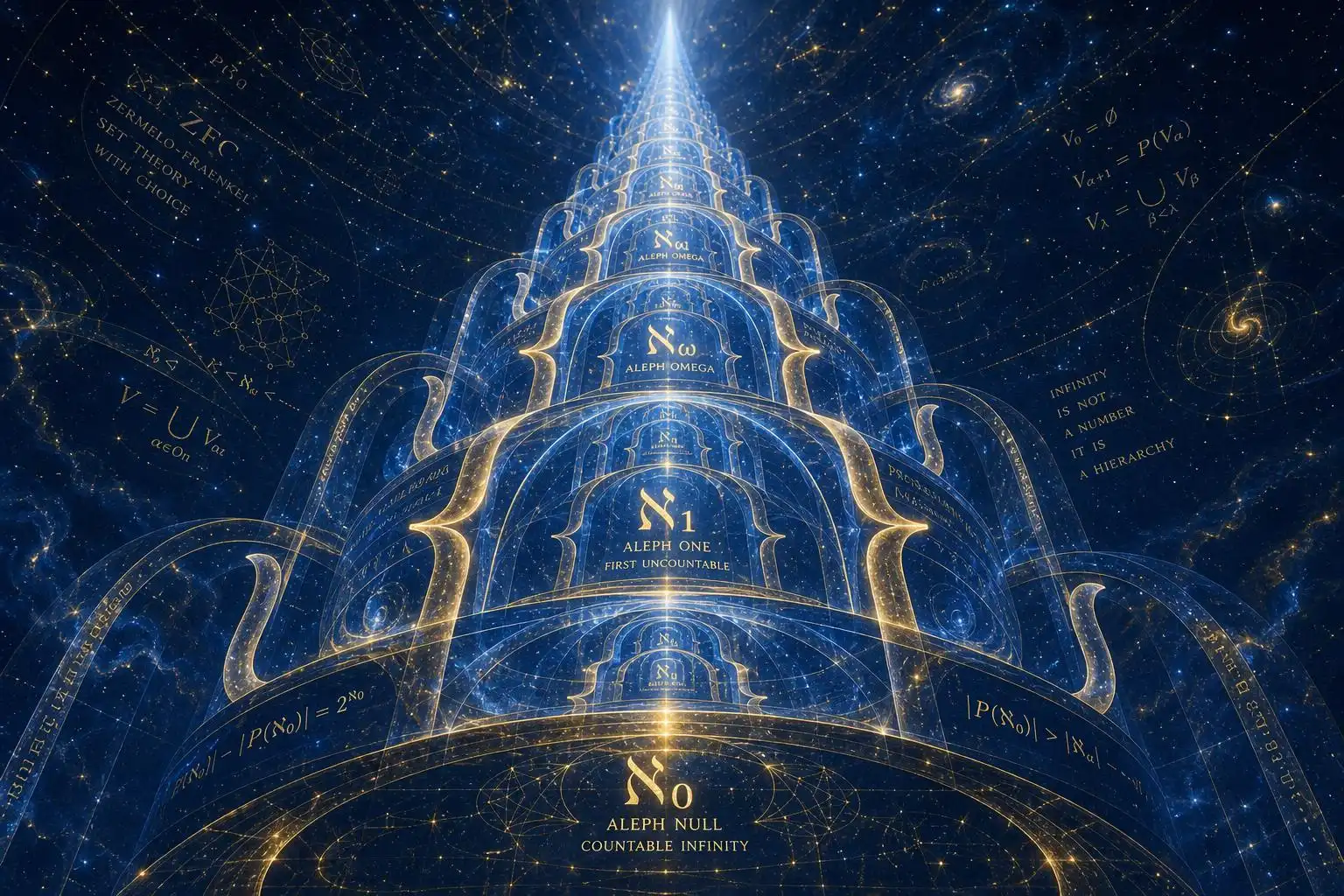

Infinity is not a number. Let’s get that out of the way first, because almost every confusion about infinity traces back to treating it like one — plugging it into equations, adding things to it, dividing by it, as if it were just a very large integer sitting at the end of the number line. It isn’t. Infinity is a size, or more precisely, a property that certain collections have: the property of going on without end. And once you accept that, something extraordinary becomes possible. You can start comparing infinities — and discover that some are genuinely, provably larger than others.
This isn’t philosophy. It isn’t a metaphor. It is rigorous mathematics, worked out in the 1870s by a German mathematician named Georg Cantor, and it remains one of the most beautiful and brain-bending results in all of human thought.
Counting Without Numbers
Before we can compare infinities, we need to rethink what “counting” means.
When you count a pile of coins, you’re doing something subtle: you’re matching each coin to a number — one, two, three — and stopping when the coins run out. Mathematicians call this a one-to-one correspondence, or a bijection. Each coin gets exactly one number; each number gets exactly one coin. The size of the pile is whatever number you land on at the end.
Now here’s the key insight: you don’t actually need the numbers. You could count two piles of coins by matching them directly against each other — left hand, right hand, one coin at a time. If both piles run out at the same moment, they’re the same size. No counting required. This works even when the piles are enormous — or infinite.
Two infinite collections are defined to be the same size (mathematicians say they have the same cardinality) if you can build a perfect one-to-one correspondence between them. Every element of one collection is paired with exactly one element of the other, with nothing left over on either side.
The First Surprise: The Integers and the Even Numbers Are the Same Size
Consider the natural numbers — 1, 2, 3, 4, 5, … — and the even natural numbers — 2, 4, 6, 8, 10, … The even numbers are a subset of the naturals. Intuitively, there should be half as many of them. But watch what happens when we try to build a correspondence:
1  ↔  2
2  ↔  4
3  ↔  6
4  ↔  8
5  ↔  10
n  ↔  2n
Every natural number n is paired with the even number 2n. Every even number is hit exactly once. Nothing is left over. The correspondence is perfect. By our definition, the two collections are the same size.
This feels wrong. It should feel wrong. But the wrongness is in our intuition, not in the math. Infinite sets don’t follow the same rules as finite ones. A part can be as large as the whole. This is actually so characteristic of infinite sets that some mathematicians use it as the definition of infinity: a set is infinite if and only if it can be matched with a proper part of itself.
The same trick works for the integers (…−2, −1, 0, 1, 2, …) and even for all fractions. Cantor showed that the fractions — called rational numbers, any number expressible as p/q where p and q are whole numbers — can be listed in a sequence and matched one-to-one with the natural numbers. The argument involves a clever zigzag through an infinite grid, and the conclusion is astonishing: there are no more fractions than there are whole numbers. Both collections have the same infinite size, which Cantor called ℵ₀ (aleph-null, or aleph-zero), the smallest infinity.
The Second Surprise: The Real Numbers Cannot Be Listed
So far, every infinite set we’ve looked at has turned out to be the same size. You might start to wonder: is there only one infinity after all?
Then Cantor dropped his bombshell.
Consider the real numbers — every point on the number line, including not just fractions but also irrational numbers like √2, π, and e. Cantor proved that no matter how cleverly you try, you cannot list all the real numbers. There is no sequence, no zigzag, no scheme that matches every real number to a natural number. The real numbers are a strictly larger infinity than the natural numbers.
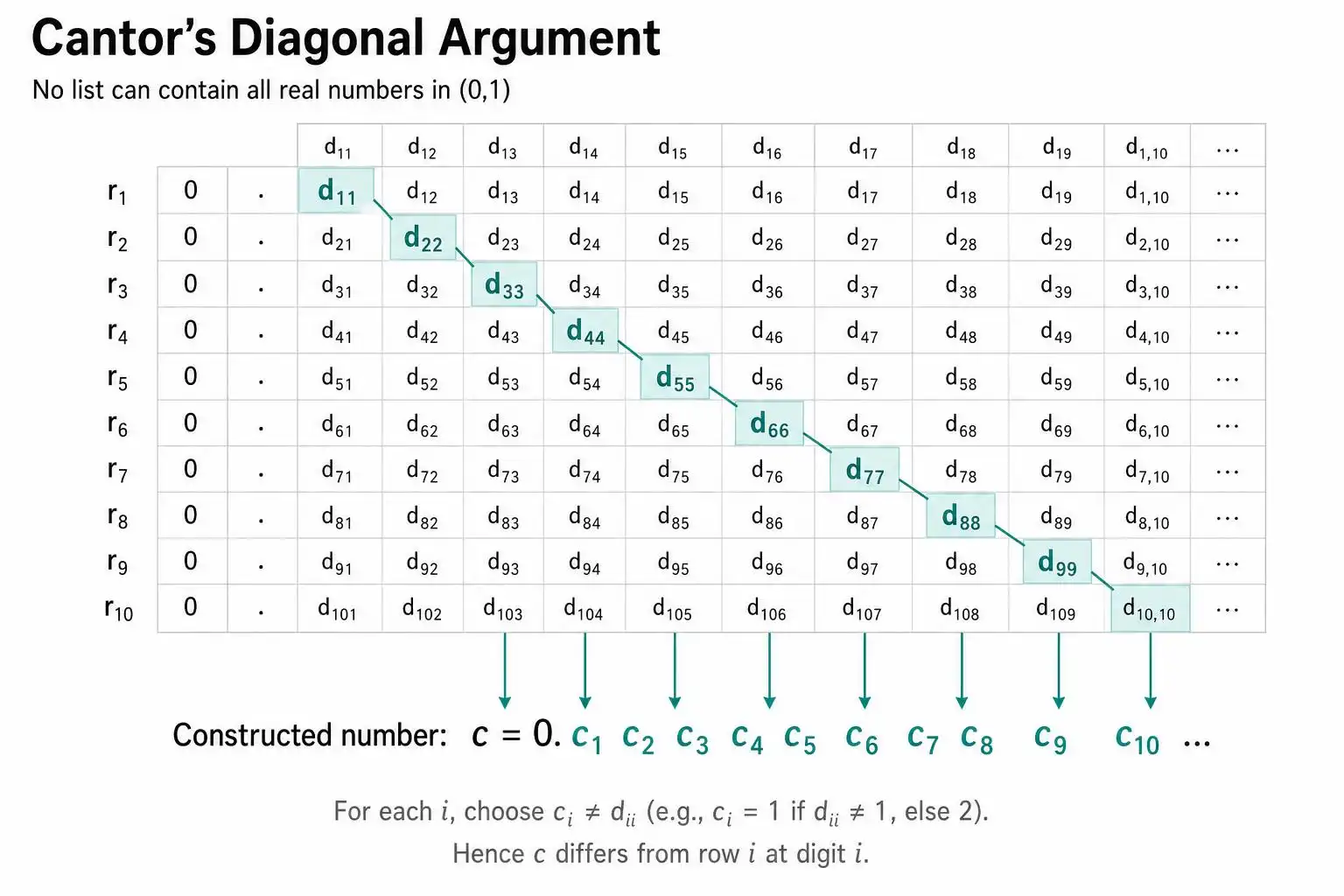
The proof is one of the most elegant in mathematics. It’s called Cantor’s diagonal argument, and you can follow every step.
Suppose someone claims they have listed all the real numbers between 0 and 1. Their list looks something like this, where each number is written in decimal:
1st number:  0.4 1 5 9 2 6 5 …
2nd number:  0.7 1 8 2 8 1 8 …
3rd number:  0.3 3 3 3 3 3 3 …
4th number:  0.1 4 1 4 2 1 3 …
5th number:  0.5 0 0 0 0 0 0 …
…
Now we construct a new number by looking at the diagonal — the first digit of the first number, the second digit of the second number, the third digit of the third number, and so on. In our example, those digits are 4, 1, 3, 4, 0, …
Now change every one of those digits by a simple rule: replace each diagonal digit with 1 if it is not 1, and with 2 if it is 1. Our diagonal digits become 2, 2, 2, 2, 1, …, so our new number is 0.22221…
Here is the killer question: is this new number on the list?
- It can’t be the 1st number, because its 1st digit (2) differs from the 1st number’s 1st digit (4).
- It can’t be the 2nd number, because its 2nd digit (2) differs from the 2nd number’s 2nd digit (1).
- It can’t be the nth number, because its nth digit was deliberately constructed to differ from the nth number’s nth digit.
It differs from every number on the list in at least one decimal place. So it’s not on the list — but it’s a perfectly valid real number between 0 and 1. The list was supposed to contain all such numbers. Contradiction.
No list can work. The real numbers cannot be matched with the natural numbers. They form a strictly larger infinity, which Cantor called the cardinality of the continuum, often written 𝔠 or 2^ℵ₀.
A Tower of Infinities
Once you have two different infinities, you can build more. Cantor proved a general theorem: given any set, the collection of all its subsets (called the power set) is always strictly larger. Apply this to the natural numbers, and you get an infinity larger than ℵ₀. Apply it again, and you get one larger still. The process never stops. There is no largest infinity. There is an infinite tower of infinities, each one dwarfing all those below it.
This result was so radical that Cantor’s contemporaries resisted it fiercely. The great mathematician Leopold Kronecker called Cantor a “corrupter of youth.” Henri Poincaré described set theory as a disease. Cantor, who struggled with depression throughout his life, died in a sanatorium in 1918. Within decades, the mathematical community had completely reversed course. David Hilbert, the era’s leading mathematician, declared: “No one shall expel us from the paradise that Cantor has created.”
A Real-World Echo: Compression and Information
You might wonder whether any of this matters outside the paradise of pure mathematics. Here’s one place it quietly shows up.
When engineers design data compression algorithms — the kind that shrink image files, audio files, or video — they run into a fundamental wall that is, at its root, a consequence of Cantor’s ideas.
Think of a digital file as a finite string of bits. There are a finite number of possible files of any given size. A compression algorithm takes a file and maps it to a shorter file. But if the shorter file has fewer bits, there are fewer possible short files than long ones. By pure pigeonhole logic, any compression scheme must make some files larger, not smaller — because you can’t squeeze every long string into a shorter one without collisions. This is called the incompressibility result, and it’s a finite echo of Cantor’s uncountability: you cannot fit a larger set into a smaller one without losing something.
The deeper version is this: almost every real number — in the precise Cantorian sense — is incompressible. The numbers we can write down, compute, or describe in any finite language form only a countable collection (since there are only countably many finite sentences). The rest — the overwhelming, uncountable majority of real numbers — cannot be named, described, or computed at all. They exist, in a rigorous mathematical sense, but they are forever beyond our reach. The “normal” numbers we work with every day are, in Cantor’s universe, the rarest of exceptions.
The Usable Insight
Here is the mental model to carry away: size is about matchmaking, not magnitude. Two collections are the same size if you can pair them perfectly, one-to-one. By that measure, the even numbers are as numerous as all whole numbers, and the fractions are no more plentiful than the counting numbers. But the real numbers — the full, unbroken number line — are a categorically larger kind of infinity, and no list, no matter how long, can exhaust them.
That gap between the countable and the uncountable is one of the deepest fault lines in mathematics. It separates what can be computed from what cannot, what can be named from what must remain nameless, what can be compressed from what cannot be shrunk. Cantor found the fault line with nothing more than the idea of a list and a clever diagonal. The universe of mathematics has never looked quite the same since.


Leave a Reply