

Strike a piano key and you’re not just making a sound — you’re setting off a chain of mathematics so elegant it feels designed. The ancient Greeks noticed it first, and physicists have been marveling at it ever since: music and math are not distant cousins. They are, in a very real sense, the same thing wearing different clothes.
Let’s start from scratch, with nothing but a vibrating string.
A String, a Frequency, and a Fraction
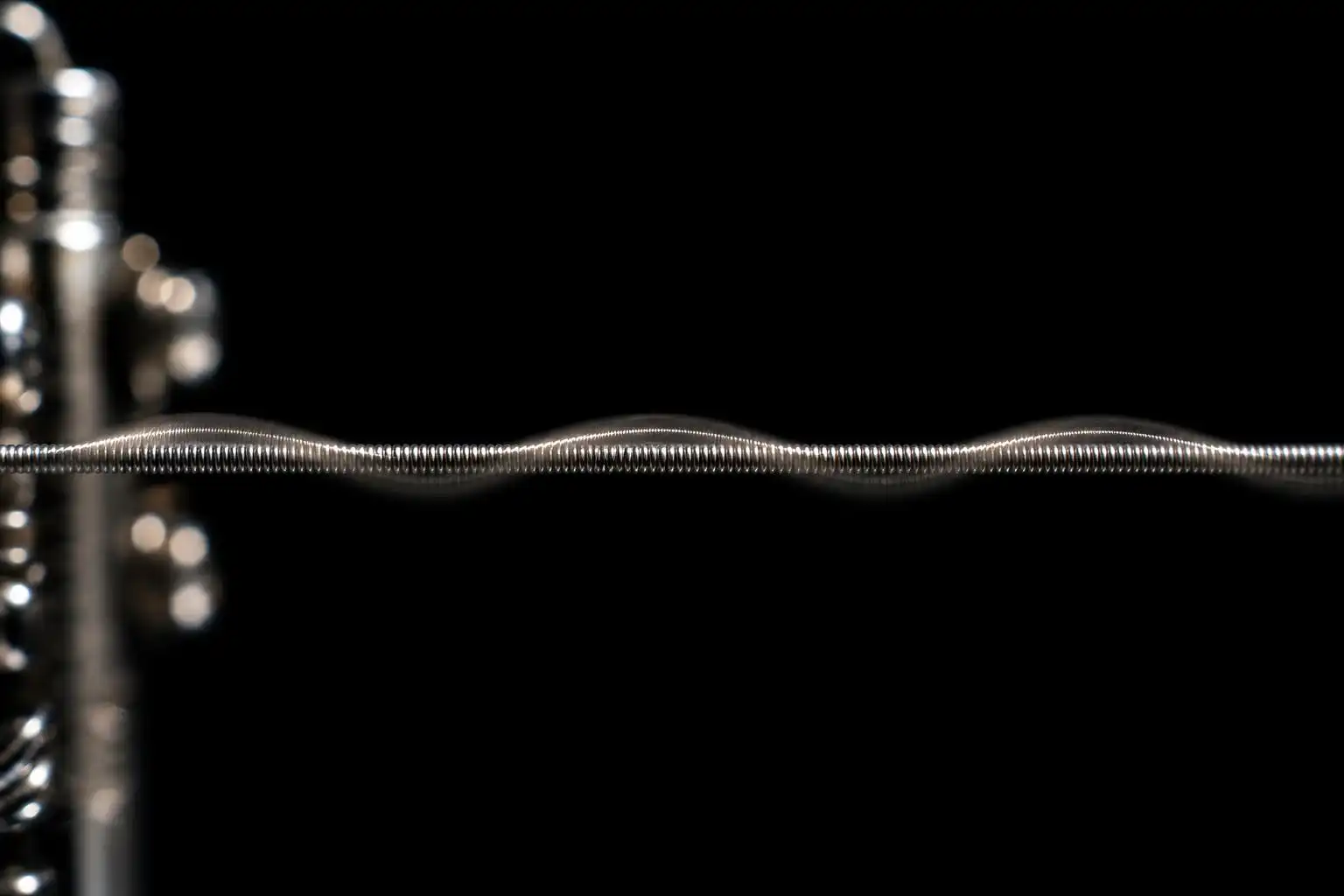
When you pluck a guitar string, it vibrates back and forth, pushing air molecules into the pressure waves your ears interpret as pitch. The number of complete back-and-forth cycles per second is the frequency, measured in hertz (Hz). A higher frequency means a higher pitch. In common modern concert tuning, the note A above middle C — the standard tuning reference — is set to 440 Hz.
Now here’s where the magic begins. If you lightly press your finger to the exact midpoint of that guitar string and pluck again, you’ve forced the string to vibrate in two equal halves. Each half is shorter, so it moves faster. The new frequency is exactly 880 Hz — double the original.
That doubling is the definition of an octave. The note you hear at 880 Hz is still called A. It sounds “the same but higher.” Across many musical cultures, this relationship has been recognized in some form: a note and its double often feel so similar that they are treated as equivalent in character. That’s not a cultural accident — it’s physics. When two frequencies share a 2:1 ratio, their wave patterns align so regularly that the human auditory system perceives them as closely related.
So our first rule of music math: go up one octave = multiply frequency by 2.
| Note | Frequency |
|---|---|
| A₃ | 220 Hz |
| A₄ | 440 Hz |
| A₅ | 880 Hz |
| A₆ | 1760 Hz |
Each row is exactly twice the previous. That’s a geometric sequence — the same kind of relentless doubling that drives compound interest and viral epidemics.
The Trouble With Fifths
The octave is clean and simple. But music needs more than two notes. How do we fill in the gaps?
The ancient Greeks, particularly Pythagoras, noticed a second beautiful ratio hiding in vibrating strings. If you shorten a string to two-thirds of its original length, you get a frequency in a ratio of 3:2 with the original. That interval — a frequency ratio of 3 to 2 — is what musicians call a perfect fifth. Play A at 440 Hz, then play the note at 660 Hz (= 440 × 3/2), and the result is a sound so consonant it forms the backbone of virtually every musical tradition.
Here’s the natural idea: what if you just kept stacking perfect fifths to build a full musical scale? Start at A = 440 Hz, multiply by 3/2 repeatedly, and drop back down by octaves (dividing by 2) whenever you go too high. After 12 such steps, you should — in theory — land back on A, just several octaves up.
Let’s check the math. After 12 perfect fifths, your frequency has been multiplied by:
left(3/2right)12 = 531441/4096 ≈ 129.746
Meanwhile, 7 octaves up from your starting note means multiplying by:
27 = 128
Those two numbers — 129.746 and 128 — are close, but they are not equal. The gap between them, roughly a factor of 129.746/128 ≈ 1.0136, is called the Pythagorean comma. It’s small enough that you might not notice it in a single chord, but stack up enough of it and your instrument drifts out of tune. Keyboards built on pure Pythagorean tuning sound gorgeous in one key and increasingly sour as you move to others.
For centuries, musicians and instrument makers wrestled with this problem. Different eras invented different compromises — “temperaments” — that fudged certain intervals slightly to make more keys usable. Bach’s Well-Tempered Clavier is generally understood as a showcase for well-tempered approaches: tuning systems in which all 24 major and minor keys were playable, if not perfectly pure, though the exact tuning Bach intended is still debated.
Equal Temperament: The Irrational Solution
The solution that won — the one used in virtually every piano, guitar, and synthesizer today — is called equal temperament, and it’s a triumph of mathematical thinking over acoustic purity.
The idea: instead of building the scale from pure ratios, divide the octave into 12 equal steps. Each step, called a semitone, is the same multiplicative size. Since 12 steps must multiply together to give you a factor of 2 (one octave), each step must be:
one semitone = 21/12 ≈ 1.05946
That’s the twelfth root of 2. It’s an irrational number — its decimal expansion never terminates or repeats — which means no interval in equal temperament (except the octave itself) is a perfectly pure ratio of whole numbers. Every fifth, every third, every fourth is ever-so-slightly out of tune compared to nature’s own ratios.
And yet it works, beautifully, because the approximations are so close that most listeners can’t detect the difference:
| Interval | Pure ratio | Equal temperament ratio | Difference |
|---|---|---|---|
| Octave | 2.0000 | 2.0000 | 0.000% |
| Perfect fifth | 1.5000 | 1.4983 | −0.113% |
| Perfect fourth | 1.3333 | 1.3348 | +0.113% |
| Major third | 1.2500 | 1.2599 | +0.793% |
The fifth is off by barely a tenth of a percent. Among the intervals listed here, the major third is the largest offender at about 0.8% — trained ears can hear it as a very slight “beating,” a gentle wavering in the sound — but the payoff is enormous: you can play in any key, modulate freely, and your instrument never sounds catastrophically out of tune.
Worked Example: Building a Scale from A₄
Let’s make this concrete. Starting from A₄ = 440 Hz and applying the equal-temperament formula, the frequency of any note n semitones above A₄ is:
f(n) = 440 × 2n/12
Here’s the full chromatic scale from A₄ to A₅:
| Semitones (n) | Note | Frequency (Hz) |
|---|---|---|
| 0 | A | 440.00 |
| 1 | A♯/B♭ | 466.16 |
| 2 | B | 493.88 |
| 3 | C | 523.25 |
| 4 | C♯/D♭ | 554.37 |
| 5 | D | 587.33 |
| 6 | D♯/E♭ | 622.25 |
| 7 | E | 659.26 |
| 8 | F | 698.46 |
| 9 | F♯/G♭ | 739.99 |
| 10 | G | 783.99 |
| 11 | G♯/A♭ | 830.61 |
| 12 | A | 880.00 |
Notice that n = 7 gives E at 659.26 Hz. The pure perfect fifth above 440 Hz would be 660 Hz. The difference is 660 − 659.26 = 0.74 Hz — less than one vibration per second. A concert violinist might wince; most listeners won’t notice at all.
And n = 12 gives exactly 880 Hz = 440 × 2. The octave is preserved perfectly. That’s the whole point: equal temperament sacrifices the purity of every other interval to keep the one ratio — 2:1 — that the ear finds truly non-negotiable.
Why Logarithms Are the Language of Pitch
Here’s a beautiful consequence of this system. Because pitch is built on multiplicative steps (each semitone multiplies frequency by the same factor), our perception of pitch is inherently logarithmic.
When musicians talk about intervals — the “distance” between two notes — they mean something multiplicative, not additive. Going from 440 Hz to 880 Hz feels the same as going from 880 Hz to 1760 Hz, even though the first jump is 440 Hz and the second is 880 Hz. What’s equal is the ratio (both are 2:1), not the raw difference.
This mirrors how human perception works more broadly. Our senses — hearing, vision, touch — tend to respond to ratios rather than absolute differences, a principle formalized as the Weber-Fechner law. The decibel scale for loudness works the same way: every 10 dB represents a tenfold increase in sound intensity, not a fixed additive step.
So when you convert the equal-temperament formula to logarithms:
n = 12 × log2!left(f/440right)
you get a formula that maps any frequency to its position on the musical scale in semitones. Plug in 880: 12 × log2(2) = 12 × 1 = 12 semitones — one perfect octave. Plug in 659.26: 12 × log2(659.26/440) ≈ 12 × 0.583 ≈ 7 semitones — the E we found above. The logarithm is literally the translator between the physics of sound (frequency in Hz) and the geometry of music (position on a scale).
The Deeper Pattern
Step back and look at what we’ve found. A vibrating string produces frequencies. The most natural relationships between those frequencies are small whole-number ratios — 2:1, 3:2, 4:3. Those ratios create consonance because their wave patterns reinforce each other with mathematical regularity. But pure whole-number ratios can’t tile an octave perfectly: the Pythagorean comma ensures they always leave a gap. So we smooth things over with the irrational number 21/12, trading perfect purity for perfect flexibility.
The result is a scale that lives at the intersection of number theory (integer ratios), irrational numbers (twelfth roots), and logarithms (the geometry of perception). Every time a pianist plays a C-major chord, they are, without knowing it, invoking all three.
The one insight to carry away: an octave is a doubling, a scale is a logarithm, and the compromise that makes all of Western music playable is the twelfth root of two — an irrational number that the ear rounds, graciously, to “close enough.”
Next time you hear a chord that makes the hair on your arms stand up, you’ll know what’s really happening: a set of frequencies whose ratios are just close enough to simple fractions that your auditory system lights up with recognition. Beauty, it turns out, is a matter of mathematical proximity.


Leave a Reply