

Pick up a snowflake, a starfish, or a sunflower, and you’re holding a mathematical argument. Nature didn’t choose those shapes randomly — it chose them because they satisfy a deep, structural property that mathematicians call symmetry. And once you learn to see symmetry the way a mathematician does, you’ll find it hiding not just in crystals and flowers, but in the laws of physics, the chords of a song, and the reason your face looks the way it does.
Let’s build the idea from scratch.
What Symmetry Actually Means
In everyday language, “symmetry” usually means “looks balanced.” But the mathematical definition is sharper and more powerful: a symmetry is any transformation you can perform on an object that leaves it looking exactly the same.
That word transformation is doing real work here. A transformation is any operation that moves, flips, or rotates something. The key question is: after you’ve done it, can you tell that anything happened?
Consider a plain circle. You can rotate it by 1 degree, 17 degrees, or 200 degrees — and it looks identical every time. The circle has infinitely many rotational symmetries. Now consider a square. Rotate it by 90 degrees: identical. By 180 degrees: identical. By 270 degrees: identical. By 360 degrees: back to start. The square has exactly four rotational symmetries. Rotate it by, say, 45 degrees, and you can immediately tell something changed — the corners are in the wrong places.
So symmetry is really about what you can do without leaving a trace.
The Language of Symmetry: Groups
Mathematicians noticed something remarkable: the set of all symmetries of an object follows very specific rules. Those rules are so important that they gave the whole structure a name — a group.
Here’s what makes a collection of symmetries a group:
- Closure: If you do one symmetry followed by another, the result is also a symmetry. (Rotate a square 90°, then rotate it 90° again — you’ve effectively rotated it 180°, which is also a symmetry.)
- Identity: There’s always a “do nothing” symmetry. (Rotating by 0° counts.)
- Inverses: Every symmetry can be undone. (If you rotate 90° clockwise, rotating 90° counterclockwise puts you back.)
- Associativity: When combining three or more symmetries, the order in which you group them doesn’t matter for the final result.
This might sound like bookkeeping, but it’s actually the foundation of a whole branch of mathematics called group theory, and it turns out to be one of the most useful structures in all of science.
A Worked Example: The Symmetries of an Equilateral Triangle
Let’s get concrete. An equilateral triangle — all three sides equal, all three angles 60° — has exactly six symmetries. Let’s name the corners A (top), B (bottom-left), and C (bottom-right).
Three rotations:
- Rotate 0° (do nothing): A stays A, B stays B, C stays C.
- Rotate 120° clockwise: A moves to where C was, C moves to where B was, B moves to where A was.
- Rotate 240° clockwise: A moves to where B was, B moves to where C was, C moves to where A was.
Three reflections (flips across a line through each corner and the midpoint of the opposite side):
- Flip across the line through A: A stays, B and C swap.
- Flip across the line through B: B stays, A and C swap.
- Flip across the line through C: C stays, A and B swap.
That’s it. Six total. No matter how you try, there’s no seventh way to rearrange an equilateral triangle so it looks unchanged. The group of symmetries of an equilateral triangle is called S₃ (the symmetric group on three elements), and it appears everywhere from chemistry to quantum physics.
Why Nature Loves Symmetry
Here’s where things get genuinely surprising. Nature doesn’t choose symmetric shapes because they’re pretty. It chooses them because symmetry is often the most efficient solution to a physical constraint.
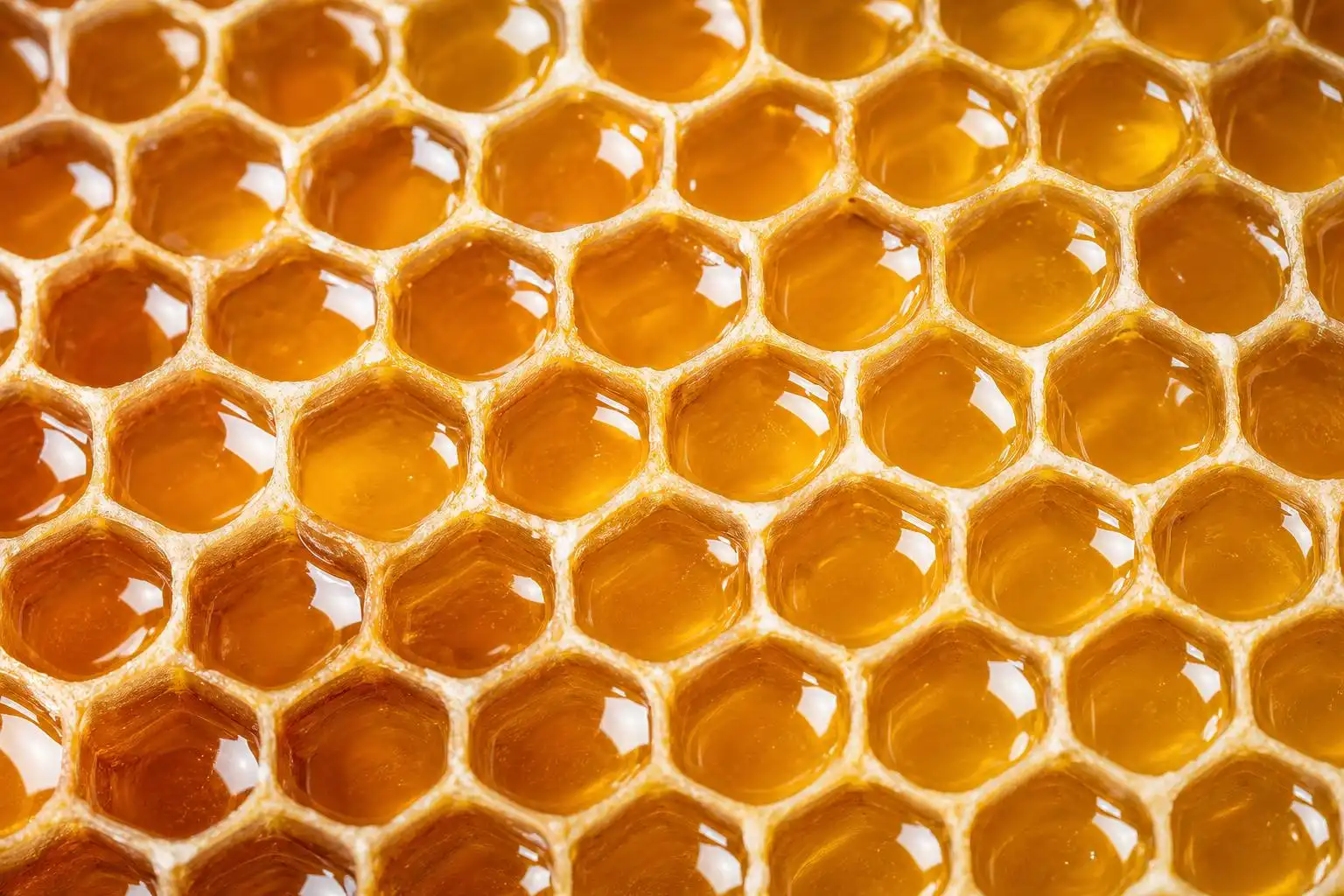
Take the honeybee’s honeycomb. Bees need to tile a flat surface with cells that hold the maximum amount of honey using the minimum amount of wax. Mathematicians proved (and it took until 1999 to do it rigorously — the “Honeycomb Conjecture”) that the regular hexagon is the only shape that solves this optimization problem. The hexagon’s six-fold symmetry isn’t decorative; it’s the geometric fingerprint of efficiency.
Or take snowflakes. A water molecule (H₂O) has a specific bond angle of about 104.5°. When water freezes into ordinary ice, hydrogen bonds help arrange the molecules into a hexagonal crystal lattice, though other ice polymorphs can form under different conditions. A snowflake’s six-fold symmetry is the macroscopic echo of that crystal structure, not simply the symmetry of a single water molecule scaled up.
The Deepest Connection: Symmetry and the Laws of Physics
In 1918, a German mathematician named Emmy Noether proved one of the most profound theorems in the history of science. It states:
Every continuous symmetry of a physical system corresponds to a conserved quantity.
This is Noether’s Theorem, and it rewrites how you think about physics.
What does it mean? Let’s unpack it with examples.
-
Time symmetry: The laws of physics are the same today as they were yesterday. You can “translate” the laws forward or backward in time and they don’t change. Noether’s theorem tells us this symmetry directly implies the conservation of energy. Energy is conserved not because of some separate rule — it’s the mathematical consequence of time being uniform.
-
Spatial symmetry: The laws of physics are the same here as they are in Tokyo or on Mars. You can translate the laws through space and they don’t change. This symmetry implies the conservation of momentum. When you push off a wall, the wall pushes back with equal force — not because Newton said so, but because space looks the same from place to place.
-
Rotational symmetry: The laws of physics are the same regardless of which direction you’re facing. This symmetry implies the conservation of angular momentum — the reason a figure skater spins faster when she pulls her arms in.
Read that again slowly. The most fundamental conservation laws in physics — the ones every engineer and chemist relies on daily — are not arbitrary rules. They are the inevitable mathematical consequences of symmetry. The universe conserves energy because it doesn’t have a preferred moment in time. It conserves momentum because it doesn’t have a preferred location in space.
Symmetry isn’t just a property of pretty shapes. It is the skeleton of physical law.
Symmetry in the Unexpected: Music and Color
Group theory also explains why certain musical chords sound harmonious and others clash. The 12 notes of the Western chromatic scale (the 12 keys in one octave on a piano) form a mathematical group under the operation of transposition — shifting every note up or down by the same interval. Major and minor chords can be described as subsets of notes within that group, and operations such as transposition and inversion reveal patterns among them; other chords, such as augmented and diminished chords, have especially clear internal symmetries. Composers like Bach exploited these symmetries intuitively; modern music theorists can now describe them precisely.
In physics, the colors of light — or more precisely, the behavior of subatomic particles — are governed by symmetry groups with names like U(1), SU(2), and SU(3). The entire Standard Model of particle physics, which describes every known fundamental particle and force (except gravity), is essentially a statement about which symmetry groups the universe obeys at the quantum level. When physicists talk about grand unification, they are often looking for a single, larger symmetry group that contains those symmetries; the broader search for a “theory of everything” also has to account for gravity and may not reduce to just one larger symmetry group.
A Mental Model You Can Keep
Here’s the usable insight to carry away: whenever something is conserved or stays the same, look for the symmetry behind it.
- A spinning gyroscope resists tipping over? Rotational symmetry → conservation of angular momentum.
- A river always flows downhill? Energy is conserved; it can’t spontaneously create itself.
- A company’s quarterly profit is the same no matter which currency you measure it in? There’s a scaling symmetry hiding in the accounting.
The mathematician’s move is to ask not “what stays the same?” but “what transformation leaves things unchanged?” — because that question leads you straight to the underlying structure. Once you find the symmetry group, you know what’s conserved, what’s possible, and often what’s forbidden.
Symmetry is the universe’s way of telling you what it cares about. And now that you speak a little of its language, you’ll hear it everywhere.


Leave a Reply