

Imagine you’re at a dinner table with three friends trying to pick a restaurant. One person wants Thai, one wants Italian, one wants Mexican, and one wants Thai again. Simple majority: Thai wins. Everyone goes home happy — or at least two of you do.
Now scale that up to a national election with dozens of candidates, millions of voters, and stakes that actually matter. Suddenly “majority rules” starts to crack at the seams. What if no candidate gets more than 50%? What if your second choice matters as much as your first? What if the order in which candidates are eliminated changes who wins entirely?
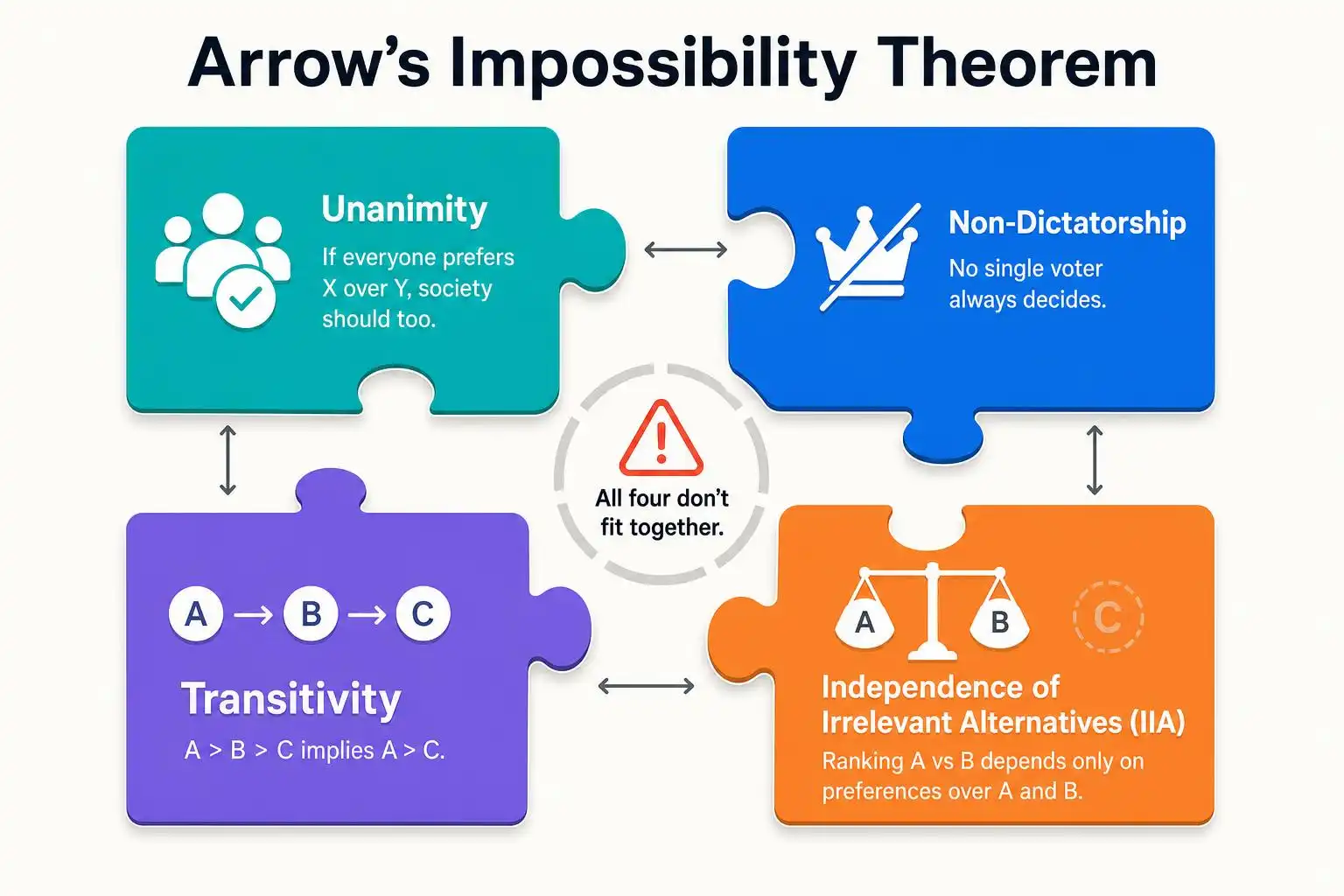
These aren’t just political complaints. They are mathematical theorems. And the punchline — proven rigorously in 1951 by economist Kenneth Arrow — is one of the most unsettling results in all of applied mathematics: there is no ranked voting system that can always, for every possible profile of individual preferences, translate those preferences into a fair collective ranking satisfying Arrow’s conditions. Not one under those assumptions. Not ever.
Let’s build up to that result from scratch, because it’s too important to just hand you the conclusion.
First, What Do We Mean by “Preferences”?
Before we can talk about fairness, we need a precise language for preferences. Mathematicians represent voter preferences as ranked lists — orderings of candidates from most to least preferred.
Say there are three candidates: Alice (A), Bob (B), and Carol (C). A voter who prefers Alice, then Bob, then Carol writes their preference as:
A > B > C
A different voter might prefer:
C > A > B
A group of voters collectively produces a preference profile — the full set of everyone’s ranked lists. The job of a voting system is to take that profile as input and produce a single ranked outcome as output: a social preference order that represents the group’s collective will.
Simple enough, right? Here’s where things get interesting.
The Condorcet Paradox: When Majorities Go in Circles
Long before Arrow, the 18th-century French mathematician the Marquis de Condorcet noticed something alarming. Consider three voters with these preferences:
| Voter 1 | Voter 2 | Voter 3 |
|---|---|---|
| A > B > C | B > C > A | C > A > B |
Now ask: who wins a head-to-head matchup between A and B?
- Voter 1 prefers A over B ✓
- Voter 2 prefers B over A ✗
- Voter 3 prefers A over B ✓
A beats B, 2 to 1. Fine.
Who wins between B and C?
- Voter 1 prefers B over C ✓
- Voter 2 prefers B over C ✓
- Voter 3 prefers C over B ✗
B beats C, 2 to 1. Still fine.
So if A beats B and B beats C, then surely A beats C?
- Voter 1 prefers A over C ✓
- Voter 2 prefers C over A ✗
- Voter 3 prefers C over A ✗
C beats A, 2 to 1.
We have A > B, B > C, and C > A — a cycle. The group’s “preferences” are not transitive. There is no winner. The majority has spoken in three different directions simultaneously.
This is the Condorcet Paradox, and it’s not a quirk or a fluke. It’s a structural property of aggregating preferences. The moment you have three or more candidates and three or more voters with sufficiently diverse tastes, cycles can appear. The group behaves irrationally even when every individual in it is perfectly rational.
Real Voting Systems and Their Flaws
Different systems try to resolve this paradox in different ways. Each one sweeps the problem under a different rug.
Plurality Voting (“First Past the Post”)
Each voter picks one candidate. The candidate with the most votes wins — even without a majority.
The flaw: It ignores everything below first place. In the 2000 U.S. presidential election, Ralph Nader received 97,421 votes in Florida. Exit polls suggested the majority of Nader voters preferred Gore as their second choice. Under plurality, those preferences were invisible. George W. Bush won Florida by 537 votes.
Whether or not you have political opinions about that outcome, the mathematical point is stark: plurality voting is highly sensitive to which candidates enter the race. A candidate can win with 34% of the vote while 66% of voters preferred someone else.
Ranked-Choice Voting (Instant Runoff)
Voters rank all candidates. The candidate with the fewest first-place votes is eliminated, and those votes are redistributed to each ballot’s next choice. Repeat until someone has a majority.
The flaw: It can violate monotonicity — the bizarre property that ranking a candidate higher can cause them to lose. Here’s a worked example with 21 voters and three candidates:
| Group | Size | Preference |
|---|---|---|
| Group 1 | 7 | A > B > C |
| Group 2 | 8 | B > C > A |
| Group 3 | 6 | C > A > B |
First-place counts: A=7, B=8, C=6. C is eliminated. C’s 6 votes go to A (their next choice). A now has 13 votes to B’s 8. A wins.
Now suppose 3 voters from Group 2 change their mind and upgrade A from third place to first place:
| Group | Size | Preference |
|---|---|---|
| Group 1 | 7 | A > B > C |
| Group 2 | 5 | B > C > A |
| Group 2 (upgraded) | 3 | A > B > C |
| Group 3 | 6 | C > A > B |
First-place counts: A=10, B=5, C=6. Now B is eliminated. B’s 5 votes go to C (their next choice). C now has 11 votes to A’s 10. C wins.
Those 3 voters ranked A higher, but that changed the elimination order and caused A to lose. That’s the real monotonicity failure: helping a candidate can hurt them; hurting a candidate can help them. The system is not always logically consistent.
Borda Count
Voters rank candidates, and each candidate receives points based on position: in a 3-candidate race, 1st place = 2 points, 2nd place = 1 point, 3rd place = 0 points. The candidate with the most total points wins.
The flaw: Borda Count is sensitive to irrelevant alternatives. Introducing a new candidate who has no realistic chance of winning can completely change the outcome among the original candidates. It also fails to elect the Condorcet winner — the candidate who would beat every other candidate in a head-to-head matchup — in some cases.
Arrow’s Impossibility Theorem
In 1951, Kenneth Arrow asked a precise question: is there any voting system, defined for every possible profile of voter rankings, that satisfies a small set of obviously reasonable fairness conditions simultaneously?
He identified four conditions — let’s call them the fairness axioms — along with the unrestricted-domain assumption that all possible individual preference profiles are allowed:
-
Unanimity (Pareto Efficiency): If every single voter prefers A over B, then the group outcome should prefer A over B. No system should override unanimous agreement.
-
Non-Dictatorship: The group’s outcome shouldn’t simply mirror one specific voter’s preferences regardless of what everyone else says. No single person should be a dictator.
-
Transitivity: The group’s preference order should be consistent. If the group prefers A over B and B over C, it must prefer A over C. (The Condorcet Paradox showed this can fail, but we want a system that guarantees it.)
-
Independence of Irrelevant Alternatives (IIA): The group’s preference between A and B should depend only on voters’ individual preferences between A and B — not on how anyone ranks a third candidate C. Adding or removing C from the race shouldn’t flip the A-vs-B outcome.
Each of these conditions sounds not just reasonable but obviously necessary for a fair election. You’d be hard-pressed to argue against any one of them.
Arrow’s theorem says: if you have three or more candidates, no ranked voting system defined for all possible preference profiles can satisfy all four conditions at once.
Every such system either allows cycles (violating transitivity), ignores unanimous agreement in some edge case, gets flipped by irrelevant candidates, or reduces to a dictatorship. The proof is a beautiful piece of logic — Arrow shows that if you demand unrestricted domain plus conditions 1, 3, and 4, you are mathematically forced to accept condition 2’s violation, meaning one voter’s preferences must always dominate. The math leaves no escape hatch.
Arrow received the Nobel Prize in Economics in 1972 partly for this result. It’s that important.
The Geometry of the Problem
There’s a lovely way to visualize why this is so hard. Imagine the set of all possible preference profiles as a high-dimensional space. Each voting system is a function that maps every point in that space to an outcome.
Arrow’s conditions are geometric constraints on that function. Unanimity, unrestricted domain and IIA together force the function to be very rigid — almost piecewise constant, jumping abruptly at certain boundaries. Transitivity forces the output to lie in a well-structured region. When you impose all these constraints simultaneously, the only functions that survive are “dictatorships” — functions that simply copy one voter’s input to the output. The geometry of the constraints leaves no room for anything else.
This is why mathematicians find Arrow’s theorem so striking: it’s not a practical limitation that better technology or smarter design could overcome. It’s a logical impossibility, as airtight as the proof that you can’t trisect an angle with a compass and straightedge.
So Is All Hope Lost?
Not quite. Arrow’s theorem applies to systems that produce a full ranking of candidates. If you relax the output to just picking a winner (not a complete ordering), you get a slightly different — and slightly more hopeful — landscape.
Approval Voting sidesteps Arrow’s framework by changing the input: instead of ranking candidates, each voter simply approves or disapproves of each candidate. You can approve as many as you like. The candidate with the most approvals wins. This reduces some spoiler dynamics and avoids some monotonicity failures, though it introduces its own quirks (your approval of C can still affect whether A or B wins, depending on how you vote).
Score Voting (also called Range Voting) goes further: each voter gives each candidate a numerical score, say 0 to 10, and the candidate with the highest average score wins. This escapes Arrow’s theorem because it changes the type of input — voters express intensity of preference, not just order. But it’s vulnerable to strategic voters who bullet-vote (giving their favorite a 10 and everyone else a 0), collapsing back toward plurality.
The Gibbard–Satterthwaite theorem, based on results published by Allan Gibbard in 1973 and Mark Satterthwaite in 1975, delivers a second blow: any deterministic voting system with three or more candidates is either a dictatorship, or it’s manipulable — meaning voters can sometimes do better by lying about their preferences than by voting honestly. Strategy is mathematically unavoidable.
The Real-World Takeaway
Here’s the usable mental model to carry away from all of this:
Every voting system is a choice about which kind of unfairness to accept. Plurality voting sacrifices voters’ secondary preferences. Ranked-choice sacrifices monotonicity. Borda Count sacrifices independence from irrelevant alternatives. There is no neutral, objective option hiding behind door number four.
This doesn’t mean all systems are equally bad — some are far better than others in practice, and the failures of ranked-choice voting, for instance, are rare and require very specific preference distributions to trigger. But it does mean that arguments about electoral systems are not arguments about finding the correct answer. They are arguments about which tradeoff you’re most willing to live with.
The next time someone tells you their preferred voting system is simply “fair,” you can smile and ask: fair according to which of Arrow’s four axioms are you willing to sacrifice? Because the math says you have to sacrifice at least one.
That’s not cynicism. That’s just the theorem.


Leave a Reply